
How the Airbnb Algorithm Works in 2026?

Isn’t this the question every host, manager, and operator wants to understand? The gears and mechanics behind the Airbnb search algorithm that we hope to tune in our favor. To appear in the most advantageous positions and ultimately increase bookings.
Airbnb uses an algorithm to decide which listings appear first when guests search for places to stay. In 2026, the Airbnb search algorithm considers factors like search relevance, price competitiveness, listing quality, guest reviews, calendar availability, and conversion behavior. Understanding how the algorithm works is one of the best ways for hosts to improve visibility and bookings.
Last updated: January 2026
Airbnb Algorithm Mechanics Explained
If your answer to the “best outcome” is more bookings and therefore more revenue (we will return to this), you should know: Airbnb also thinks this way. Every search-algorithm research article published by Airbnb has one clear theme – success is measured by increased bookings.
There are countless articles and Medium posts written by Airbnb engineers. I have read everything I could find (and understand). These extremely smart and competent people often made me question the work we do at Homesberg to decode what happens behind the scenes. But one insight stands out consistently:
The algorithm is primarily optimized to increase bookings.
- Not revenue directly.
- Not guest satisfaction directly.
- But bookings.
Guest satisfaction and revenue are treated as byproducts of higher booking volume.
Airbnb also updates its algorithm periodically based on business priorities. Sometimes they announce these changes, sometimes they don’t. (You can check our post about the 2025 Summer Release for recent updates.)
In this article, we focus on the fundamentals.
The Fundamentals of Airbnb Ranking
Before diving into the details, consider the following realities as a listing owner:
- Airbnb is a for-profit business aiming to maximize bookings.
- To get booked, you must first get clicked.
- Faster decision-making from guests improves results.
- Every listing receives an internal “probability of booking” score that determines its ranking.
- Most guests prefer more affordable options.
- If a first-time guest has a bad experience, the chance of returning to Airbnb is only eight percent.
Take a moment and think through these.
Even without insider information, because Airbnb doesn’t reveal much, what should your instinct tell you? Here are the essentials:
- Strong marketing material
- Professional photos
- Clear, honest descriptions
- Consistently high service leading to positive reviews
- Reasonable, market-aligned pricing
These are the backbone of a successful Airbnb business. If you execute these well at the higher end of reasonable pricing, you maximize your revenue.
The Airbnb “Possibility of Booking” Score
Airbnb does not disclose the exact formula behind its “possibility of booking” score, but research published by Airbnb engineers gives us a clear picture of how it works. In a nut shell they explicitly state that the core ranking model orders listings by their estimated probability of being booked. This estimate is not a simple metric. It is a machine-learned prediction shaped by dozens of signals: your click-through rate, conversion rate, price competitiveness, likelihood of cancellations, guest satisfaction risk, and even how your listing compares to others within the same search. Airbnb trains these models on real booking outcomes at massive scale, continually refining them to surface listings that guests are most likely to book and least likely to cause friction.
In short, your ranking is heavily influenced by how reliably your listing attracts clicks, turns views into bookings, maintains high ratings, avoids cancellations, and delivers a smooth experience. The better your track record in these areas, the higher your “possibility of booking” score and thus your position in search.
How Guests Search on Airbnb
Every search begins with an impression. When a guest searches, Airbnb ranks listings from the highest possibility of booking to the lowest. The exact formula remains hidden, but we know it correlates heavily with:
- Low pricing
- High ratings
- High-quality recent performance
One very important behavioral insight:
Typical guests do not browse endlessly.
Airbnb openly discusses “cognitive load” – the mental effort required to choose. They try to reduce it because:
- Click-through rates drop dramatically after the first few listings
- Most users never reach the second page
- Many users move the map instead of scrolling further
Airbnb shows 18 listings per page and 15 listings on the graph in their research but counts as impressions only for the first 10.
At Homesberg, we analyzed over 2 million searches in the last six months. Here’s what we found.
Does Lower Pricing Improve Airbnb Rankings?
When isolating other factors, the answer is yes. Lower prices strongly correlate with higher rankings. Airbnb even states this openly: users are more likely to book affordable listings.
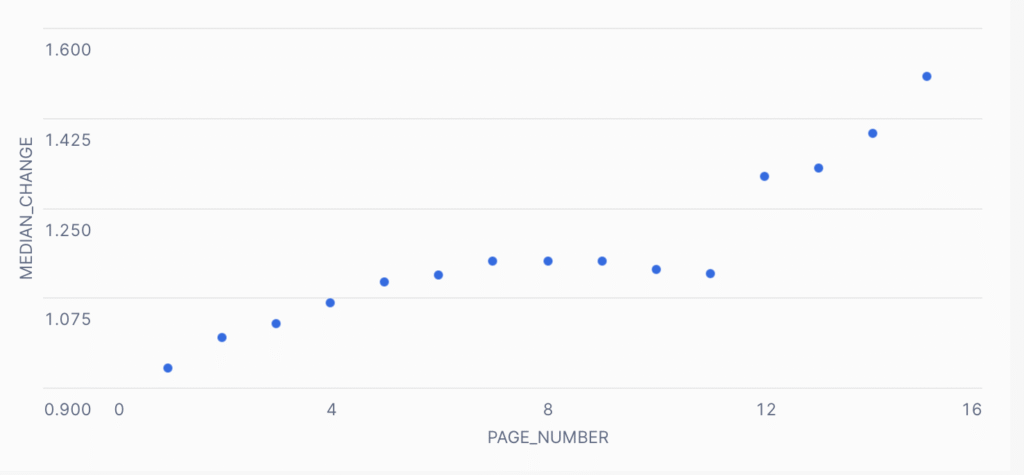
But price alone cannot take you to the top.
If your photos, reviews, or quality are weak, lowering your price won’t magically put you above well-performing listings.
However:
- Lowering your price improves your ranking relative to your previous position
- Increasing your price can sometimes maintain your current rankings increasing
your expected value if your listing already performs exceptionally. - For far-out days you can lower your rankings by increasing your price to a degree that maximises expected value.
Homesberg helps you identify exactly where this balance lies.
Serve Better, Rank Better on Airbnb
This one is obvious. Great service equals:
- Better ratings
- Higher conversion
- A stronger possibility of booking score
- Better ranking
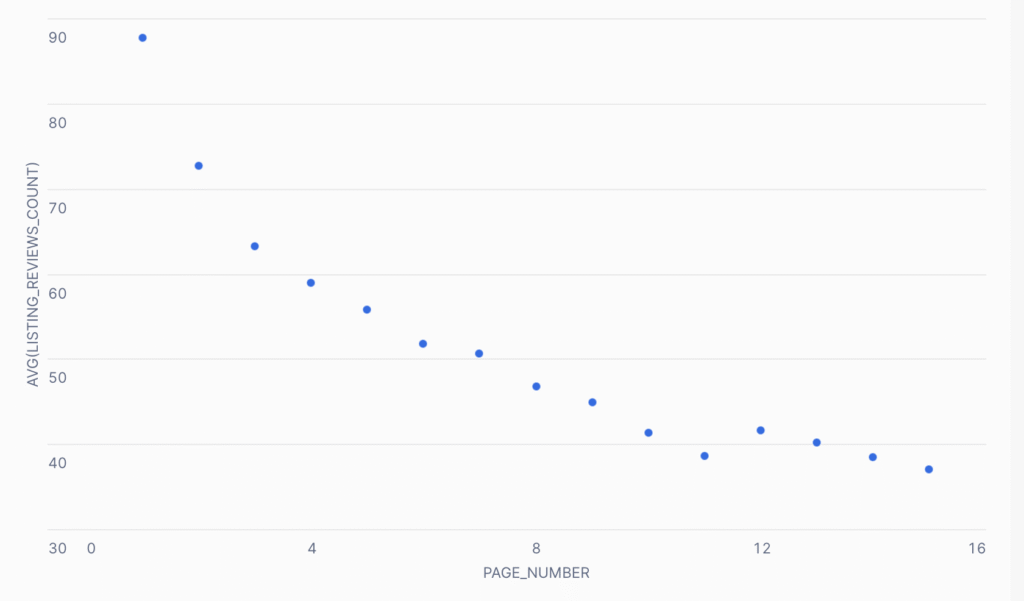
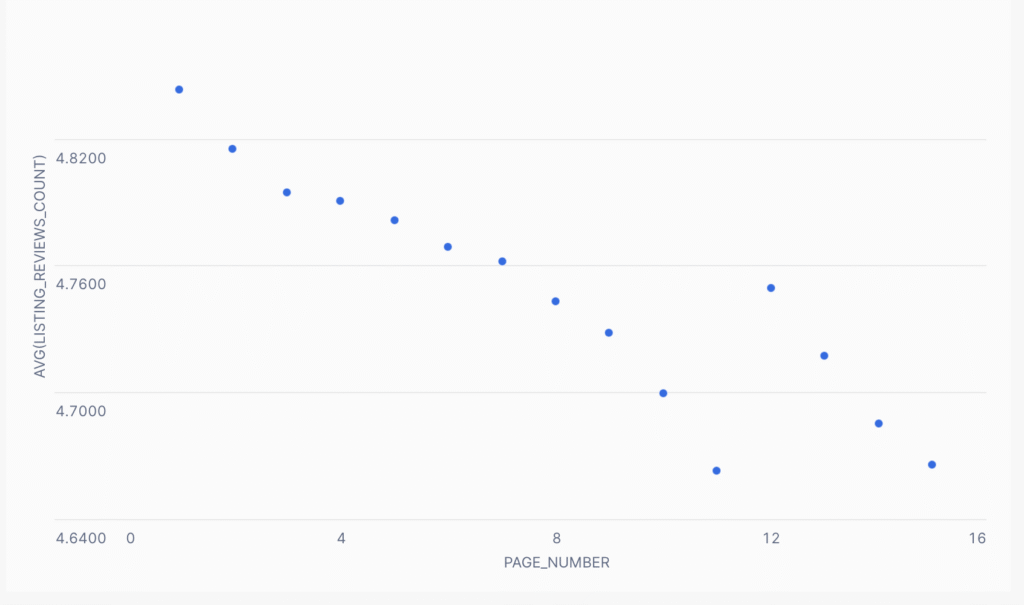
And the data confirms it.
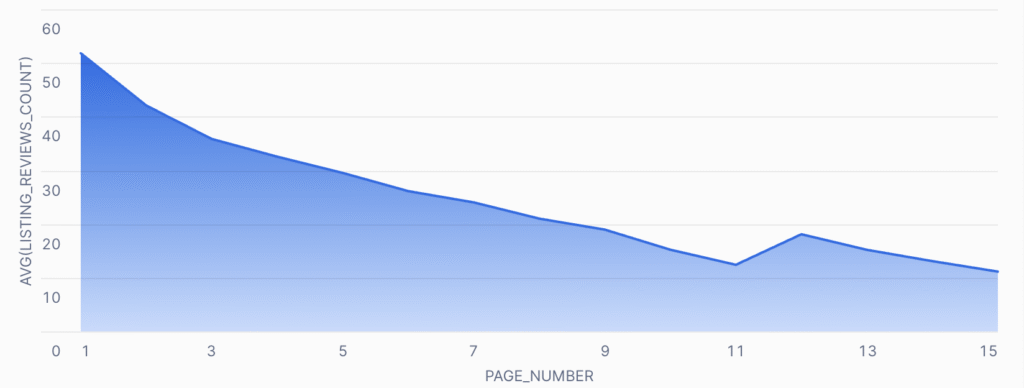
Performance starts to deteriorate after the 10th to 12th pages, but realistically, almost no one browses that far. Most guests refresh the map long before reaching page two.
Does Being a Superhost Boost Rankings?
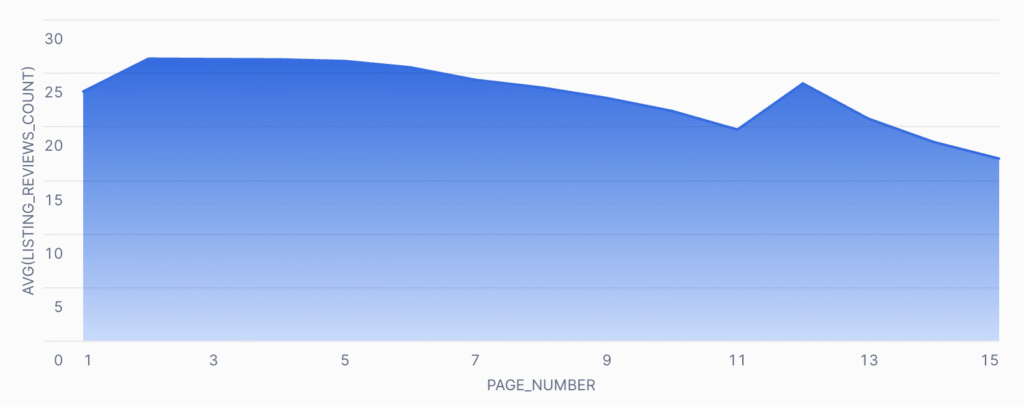
Superhost status is an achievement, especially for larger portfolios. A 4.8 average with almost no cancellations is impressive.
However:
Superhost status does not automatically boost every listing you have.
Airbnb ranks listings individually. A high-performing listing benefits, but an average listing under the same host does not get special treatment.
Does the Guest Favourite Badge Boost Rankings?
This is different.
The Guest Favourite badge signals:
- Consistent 5-star service
- Back-to-back bookings
- High guest trust
- Low friction for new guests
Airbnb relies on these listings to introduce the platform to new users, so they naturally rank higher.
For Guest Favourite listings, Homesberg delivers maximum value because:
- Many ranking factors are already satisfied
- Price becomes less influential
- You gain freedom to raise prices without losing ranking position
- You match with guests who are less price-sensitive when service quality is exceptional
Recent Airbnb Algorithm Changes: What You Should Know
Airbnb made major updates last year, including the surprising commission increase from 15% to 15.5%. We suspect investor pressure as the primary reason. They are reducing customer-service costs while aggressively acquiring new guests.
To do this, Airbnb prioritizes:
- Experienced hosts
- Consistently high ratings
- Better guest satisfaction overall
They even reduced new-listing boosts by half.
If you’re new, don’t lose hope. Airbnb still supports “cold starters,” but the bar is higher now. You simply need to perform better.
Final Thoughts
Neither demand nor Airbnb functions the way they did years ago. The market is mature and, in many cities, saturated. Strong hosts exist everywhere.
If you want to stay competitive, stick to the fundamentals:
- Strong marketing and visuals
- Exceptional service that consistently earns 5 stars
- Market-aligned, insight-driven pricing
Get the bookings flowing. Once those foundations are in place, track your rankings with Homesberg to maximize your performance. Adjust your prices according to your ranking to increase your expected value and revenue.
About Homesberg
Climbing the rankings is simple when you stick to the fundamentals; knowing your exact position with real filters is what significantly boosts your revenue.
Homesberg is an all-in-one vacation rental management platform built around the must-have features hosts truly need: self-reliant market data collection, an Airbnb ranking tracker, a robust dynamic pricing engine, and seamless integrations with all major channels. No more juggling multiple tools or paying for underutilised features.

This is interesting, however does miss the important point that this only works in the AirBnB ecosystem. If you search outside of it (which most are doing now the rules don’t apply). Question needs to be how do you get found on searches, not how do you get found on Airbnb searches.
Hi George,
You are absolutely right about this. There is a growing notion in the industry to cut the middleman and rely on direct bookings. This is valuable, relying heavily on a single channel is risky. However, these efforts are not costless and big OTAs such as Airbnb will always provide bookings as they offer security for the guests.
For this reason it is important to know the rules of the system in order to maximize outcome.
Most importantly, since I started using Homesberg, all parameters have been working in my favor.
You will agree that an increase in occupancy from 30% to over 70% is not small at all, and when we consider that this improvement happened in a market oversaturated with apartments, this result represents a huge success.