Airbnb Revenue Management: The Complete Guide
Revenue management is one of those terms that sounds more complicated than it is, and at the same time more simple than it should be. Most hosts either ignore it entirely (setting a price and checking back occasionally) or reduce it to a single variable: nightly rate. Neither approach gets close to what the practice actually involves.
This guide covers the complete framework: what revenue management means for an Airbnb host specifically, how the core metrics connect, how dynamic pricing fits in, why search visibility is a revenue lever most tools do not measure, and what mistakes consistently cost operators real income.
This article is informational and based on general industry practices and publicly observable platform behavior. Airbnb’s algorithm, pricing dynamics, and platform rules change over time. Check Airbnb’s current host resources and consult your own data before making significant operational decisions.
What Is Airbnb Revenue Management?
Revenue management, in the short-term rental context, is the practice of maximizing total income per available night through coordinated decisions about pricing, occupancy, listing quality, and channel behavior.
It was borrowed from the hotel and airline industries, where yield management has been standard practice since the 1980s. American Airlines pioneered modern, data-driven rate optimization after deregulation opened up pricing freedom. Hotels followed with daily rate adjustments tied to occupancy forecasts.
Short-term rental revenue management inherits that logic but operates in a different environment. You are not managing a fixed-capacity hotel with predictable business travel. You are competing in a search-driven marketplace where your listing’s visibility, conversion rate, and nightly rate interact continuously. That interaction is the core of the framework.
Revenue management for an Airbnb host covers:
- Setting and adjusting the base price over time
- Using dynamic pricing to optimize each available night
- Managing visibility and search ranking position
- Aligning cancellation policy with revenue risk
- Adapting strategy by season, property type, and market conditions
- Tracking the right metrics (not just rate, but occupancy and RevPAL together)
The Core Revenue Equation
Most guides stop at price and occupancy. That framing misses a third variable that determines whether demand ever reaches your listing in the first place.
In Airbnb’s search-driven environment, the revenue equation works like this:
Revenue = Visibility × Conversion Rate × ADR
Where:
- Visibility is how prominently your listing appears in search results for relevant dates and guest types
- Conversion Rate is the probability that a guest who views the listing makes a booking
- ADR (Average Daily Rate) is the nightly price they pay
Each variable depends on the others. Raising ADR without maintaining visibility compresses booking probability. High visibility with weak conversion (poor photos, unclear description, thin review history) wastes search exposure. Strong conversion with a base price set too low fills the calendar but leaves margin on the table.
Key point: Several guides and data-driven frameworks converge on this principle: visibility is the gateway variable. Demand cannot convert if the listing is not meaningfully exposed. Traditional pricing tools often optimize for ADR and occupancy in isolation; the visibility layer is frequently left out of the equation entirely.
Homesberg was built around this three-variable model. Its pricing engine treats visibility as a directly measurable input by tracking real-time Airbnb search ranking position for each available date range. Rather than assuming that a correctly priced listing will be seen, it connects pricing decisions to observable rank movement, so adjustments are grounded in actual exposure data rather than demand forecasts alone.
ADR vs. RevPAL: Which Metric Actually Tells the Story?
Average Daily Rate measures the average nightly income across booked nights. It is the metric most hosts cite first, and it is incomplete on its own.
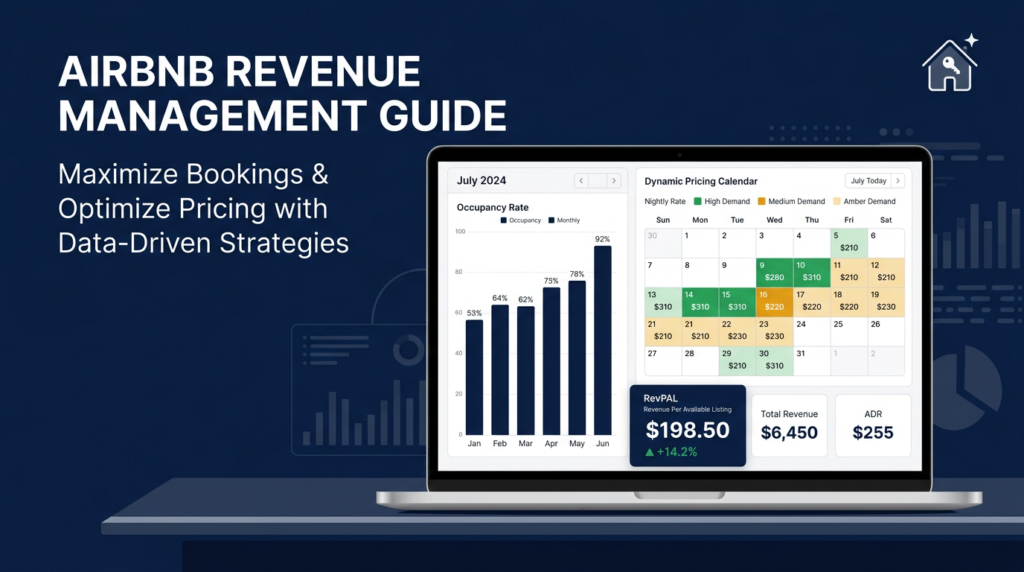
RevPAL (Revenue Per Available Listing) divides total revenue by all available nights, including unbooked ones. It combines your pricing and your occupancy into a single number.
| Metric | What it measures | What it misses |
|---|---|---|
| ADR | Revenue per booked night | Empty nights count for nothing |
| RevPAL | Revenue per available night | Context from market comparisons |
A simple example makes the gap visible:
- Strategy A: $200 ADR, 40% occupancy: RevPAL = $80
- Strategy B: $150 ADR, 75% occupancy: RevPAL = $112.50
Strategy A looks more “premium” in conversations. Strategy B generates 40% more actual income.
The right performance question is not “what is my nightly rate?” but “how much am I earning from every night I could be booked?” Homesberg’s ADR vs. RevPAL guide covers the mechanics of this tradeoff and how to use both metrics together.
Dynamic Pricing: How It Actually Works
Dynamic pricing is the continuous adjustment of nightly rates based on real-time demand signals, competitive behavior, and calendar position. The goal is not to charge the maximum possible; it is to find the optimal price for each available night, balancing occupancy and margin.
The core inputs most pricing engines factor in:
- Seasonality: Demand curves shift predictably across the year for most markets. Summer peaks, winter troughs, and shoulder transitions each carry different pricing logic.
- Lead time: How far ahead guests are booking in your area determines which pricing band is relevant for a given date.
- Day of week: Weekend and weekday demand patterns differ significantly in urban markets and leisure destinations.
- Local events: Concerts, conferences, festivals, and public holidays create temporary demand spikes that flat pricing cannot capture.
- Competitor availability: When comparable listings in your area get booked, competitive pressure for remaining inventory increases, and rates can often move up.
Key point: Dynamic pricing adjusts these variables continuously, not only when you log in.
Static pricing (setting a rate and revisiting it monthly) loses on two fronts simultaneously: overpricing during low-demand periods creates empty nights, and underpricing during high-demand periods caps revenue below what the market supports.
Homesberg handles this daily adjustment automatically, analyzing listing data across its coverage areas to keep prices calibrated to current market conditions. The engine factors in seasonality, lead time, competitor behavior, and local demand signals, updating nightly rates on a continuous basis. For a detailed walkthrough of how these inputs combine, Homesberg’s dynamic pricing in short-term rentals guide covers the mechanics from first principles.
Search-Aware Dynamic Pricing: Adding the Visibility Layer
Standard dynamic pricing engines optimize for demand forecasts: they predict when guests are likely to book and adjust rates accordingly. That is a useful starting point, but it leaves one critical question unanswered: does the price you are setting actually place your listing where bookings happen?
Airbnb search results update in near real time. A $15 rate adjustment can shift a listing from position 21 (page two) to position 9 (page one) within minutes, significantly changing booking probability. Most pricing tools do not measure this movement because they are built around demand signals, not ranking signals. The result is pricing that may be statistically optimal for demand but operationally suboptimal for visibility.
Search-aware dynamic pricing addresses this gap by adding a feedback loop: adjust price, observe ranking movement, recalibrate. Homesberg operationalizes this through its Search Visibility Feedback Loop, which runs searches that replicate real guest behavior, measures exact page and position, benchmarks first-page ADR conditions, and allows hosts to test price changes and see their impact on rank before relying on a booking to confirm the outcome. The full framework is covered in detail at Search-Aware Dynamic Pricing for Airbnb.
Setting Your Base Price
Dynamic pricing does not replace a base price. It works around one. Your base price is the year-round average nightly rate you set as the anchor for your pricing strategy, assuming stable market conditions and no extraordinary demand factors.
A common mistake is treating the base price as a floor (the minimum you will accept) rather than as a midpoint that the pricing engine moves above and below based on conditions. Setting the anchor too high produces artificially elevated prices in low-demand periods and fewer bookings as a result.
How to approach setting it:
- Benchmark your competitive set. Look at listings in your area with similar bedrooms, location tier, quality, and amenity profile. What are they pricing at? What is their occupancy?
- Calculate your cost floor. Fixed costs (mortgage or rent, insurance, base utilities) and variable costs (cleaning fees, consumables, maintenance) define the threshold below which a night generates no surplus. Your base price should sit well above this, not just above it.
- Account for your listing’s position in the market. New listings without reviews typically need to start slightly below comparables to build the conversion momentum that feeds ranking signals.
- Adjust based on rolling performance. Occupancy consistently above 80% is a signal the base price may be set too low. Occupancy consistently below 50% across a full month suggests pricing or listing quality needs attention.
A structured benchmark approach uses four market tiers: budget, economy, midscale, and top-tier.
Visibility as a Revenue Lever
Here is where most revenue management frameworks stop too early.
Airbnb is a search-driven marketplace. A listing that does not appear on the first page for its key dates has limited booking probability regardless of how well the price is set. Ranking position determines exposure; exposure determines whether demand converts into reservations at all.
Ranking is shaped by two categories of factors:
Slow-moving factors (define the performance band)
These build over time and determine the ceiling and floor of where a listing can realistically rank:
- Guest reviews: rating quality and recency, with recent reviews typically carrying more weight
- Historical conversion rate: how often listing views turn into bookings
- Listing content: photo quality, description completeness, amenity accuracy
- Response rate and operational reliability
- Cancellation behavior and service-related signals
The fast-moving lever: price
Unlike reviews or listing content, price changes reflect in Airbnb search results almost immediately. A rate adjustment can move a listing from page two to page one within minutes.
Key point: Price moves a listing within its performance band. It does not redefine the band itself. A listing with weak fundamentals will not achieve consistent first-page placement purely through discounting. Conversely, listings with strong performance signals maintain pricing flexibility without losing visibility.
Search-aware dynamic pricing integrates this visibility layer into pricing decisions. Instead of optimizing price based on demand forecasts alone, it measures how each price change affects actual search ranking position, treating visibility as a controllable economic variable rather than a background condition. The mechanics behind this approach are covered in the Search-Aware Dynamic Pricing section above.
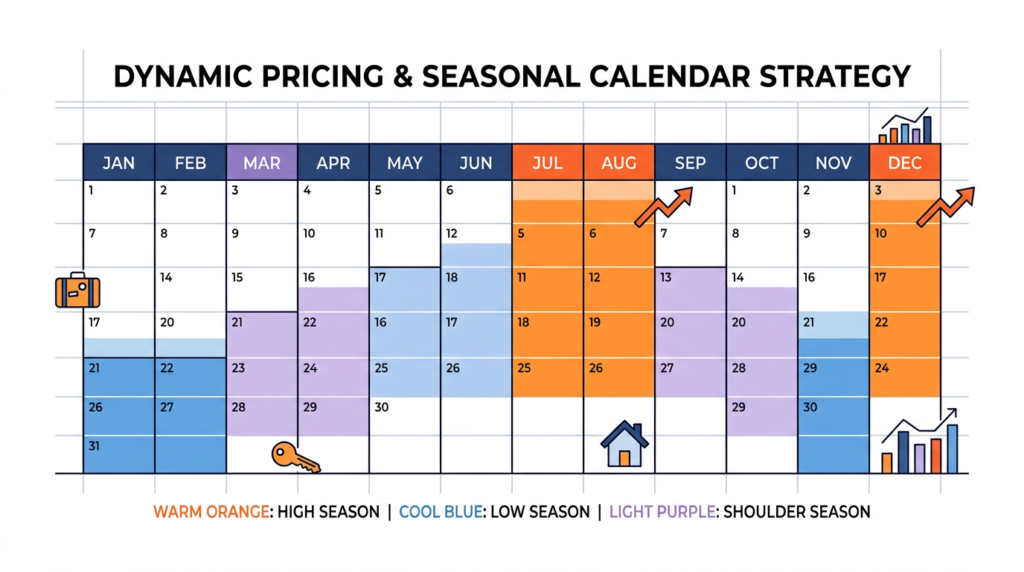
Seasonal Strategy and Demand Cycles
Revenue management is not a one-setting-for-all-seasons approach. The decisions that protect margin in high season often compress bookings in low season, and vice versa.
High season
Peak demand periods support higher ADR without sacrificing visibility. The goal is to price aggressively enough to capture margin while staying visible for the dates that matter.
Key moves in high season:
- Adjust minimum night requirements to prevent low-value short fills between premium multi-night stays
- Raise base price and allow the pricing engine to optimize each date individually
- Monitor competitor availability: when similar listings get booked, pricing power for remaining inventory often increases
Low season
The priority shifts toward occupancy. An empty night in low season contributes nothing. Slightly lower rates that fill calendar gaps contribute to both RevPAL and to the conversion signals that feed back into ranking.
Patterns to avoid in low season:
- Carrying the high-season base price into low-demand months
- Adding last-minute premiums when the calendar is sparse and booking probability is already low
- Ignoring mid-week occupancy, which often represents quick, high-confidence wins in urban and business-travel markets
Shoulder season
Shoulder periods are where strategy gets most complex. Demand is uneven, booking windows vary by week, and the right call often changes from one fortnight to the next. This is where real-time visibility data and competitive monitoring produce the most meaningful advantages over static pricing.
Cancellation Policy and Revenue Risk
Cancellation policy interacts with revenue management in ways that are often underestimated.
A more restrictive policy protects the per-booking revenue guarantee but may reduce total booking volume and conversion rate, which affects both RevPAL and ranking signals. A more flexible policy lowers the psychological barrier to booking, which can improve occupancy, but exposes near-term calendar revenue to last-minute cancellations.
The right framework is not “which policy protects me most” but “how quickly can I re-book a canceled date?”
- Urban listings with strong demand flow can typically absorb flexible policies because rebooking probability is high and lead times are short.
- High-value seasonal properties with long lead times face more asymmetric risk: a summer week that cancels in April is significantly harder to resell at the same rate in May.
Treating cancellation policy as a standalone setting, independent of your pricing position and market type, is a common source of preventable revenue loss.
Listing Quality and Review Performance
Revenue management frameworks frequently underweight the quality side of the equation. But listing fundamentals directly influence two of the three variables: conversion rate and the performance band that determines how much pricing flexibility you have.
Strong listing fundamentals include:
- Photography: Professional, well-lit images remain the single highest-leverage listing investment for most hosts. Conversion drops significantly when photos fail to represent the space accurately or feel visually weak.
- Description accuracy: Listings that over-promise and under-deliver accumulate negative review signals over time, which compress the ranking performance band regardless of pricing strategy.
- Amenity completeness: Airbnb’s search filters allow guests to narrow results by specific amenities. Incomplete listings get filtered out before price becomes a consideration.
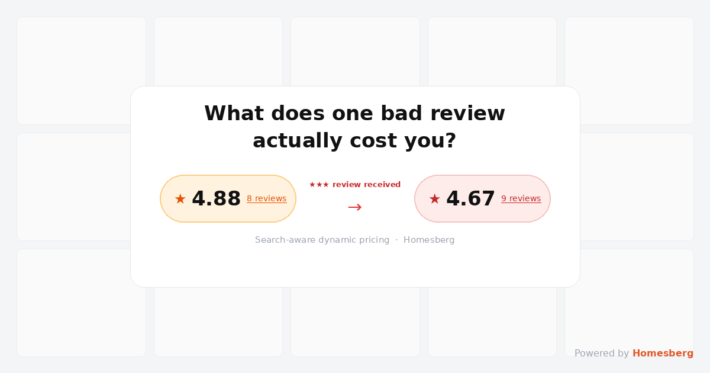
- Review recency: Recent reviews carry disproportionate weight in most ranking signal analyses. A listing with 60 older reviews and none in the past 90 days may underperform compared to a newer listing with 15 recent, positive ones.
Key point: Listing quality defines the ceiling of what pricing strategy can achieve. No pricing engine compensates for a listing that consistently underdelivers guest expectations.
Common Revenue Management Mistakes
These patterns appear repeatedly across hosts at every scale of operation:
- Treating ADR as the primary success metric. High ADR with low occupancy often means lower total income than a more balanced approach. RevPAL is the more honest number.
- Setting a price and revisiting it quarterly. Markets move continuously. New supply enters, events appear and disappear, competitor behavior shifts week to week. Monthly reviews are a minimum; weekly adjustments in competitive markets are more effective.
- Ignoring the visibility layer. Optimizing price without understanding where the listing ranks for its available dates means pricing decisions are partially blind to exposure reality.
- Using the same strategy across all seasons. Low-season logic and high-season logic are different. The same settings applied year-round produce suboptimal results in both directions.
- Treating cancellation policy as independent from revenue strategy. The two are connected through occupancy risk, conversion behavior, and the rebooking probability specific to the market and property type.
- Neglecting listing fundamentals. A pricing engine cannot compensate for weak photos, outdated amenity listings, or declining review quality.
- Over-relying on automated pricing without periodic strategic review. Automation handles continuous daily adjustment well. It does not replace the periodic decision to revisit base price, minimum nights, and listing positioning.
A Practical Revenue Management Checklist

Use this for a periodic review of your listing’s revenue position. Monthly is a reasonable default; weekly makes sense during high-demand periods or when occupancy is underperforming.
Metrics
- Calculate current RevPAL alongside ADR
- Review occupancy by month for the past 90 days
- Compare performance against comparable listings in your competitive set
Pricing
- Is your base price calibrated to current market conditions, not last season’s?
- Are minimum stay requirements aligned with current demand patterns?
- Are you using last-minute discounts intentionally rather than as a default?
Visibility
- Where does your listing rank for its next 5 available date ranges?
- Does the first-page ADR benchmark for your market suggest room to raise rates or pressure to lower?
- How does your conversion rate (impressions to bookings) compare to the previous period?
Listing quality
- Have you received a guest review in the past 60 days?
- Are photos current and consistent with the listing as guests will actually find it?
- Are all amenities and description fields fully accurate?
Seasonal
- Is your current pricing strategy calibrated for this season, not carried over from the last one?
- Are key upcoming dates (holidays, local events, shoulder transitions) handled with specific settings rather than default rates?
Conclusion
Revenue management for Airbnb hosts is not a single setting or an occasional adjustment. It is a continuous practice that connects pricing, visibility, listing quality, and demand intelligence into an operating system for the listing.
Several principles run through every section of this guide. ADR alone is an incomplete metric: RevPAL tells a more accurate story about how well a listing is actually performing. Price is not only a revenue variable: it is a visibility lever that moves a listing within its competitive performance band in real time. Seasonal strategy should change: high season, low season, and shoulder periods call for different logic, and applying one approach year-round costs money in both directions. Listing quality defines the ceiling: no pricing strategy compensates for fundamentals that consistently fall short of guest expectations.
The hosts who manage revenue well treat it as a system, not a periodic task.
If you want to bring a more data-driven layer into this process, Homesberg combines dynamic pricing, search visibility tracking, and market benchmarking in one platform, built specifically for short-term rental operators on Airbnb and other channels. It is where the revenue equation described in this guide becomes directly measurable and actionable.
Revenue management is one of those areas where consistent attention compounds over time.
Frequently Asked Questions
What is revenue management for Airbnb hosts?
Revenue management for Airbnb hosts is the practice of systematically maximizing income from a short-term rental by coordinating pricing, occupancy, listing visibility, and quality decisions. It draws on frameworks from hotel yield management, adapted for the dynamics of a search-driven booking platform.
Is dynamic pricing the same as revenue management?
No. Dynamic pricing is one component of revenue management, not the whole. Revenue management includes dynamic pricing but also covers base price strategy, listing quality, cancellation policy, channel decisions, and visibility positioning in search results.
How do ADR and RevPAL differ?
ADR (Average Daily Rate) measures revenue per booked night. RevPAL (Revenue Per Available Listing) measures revenue per available night, including unbooked ones. RevPAL is a more accurate indicator of overall listing performance because it accounts for both rate and occupancy together.
Does a higher price always improve revenue?
Not necessarily. Raising price without monitoring its effect on search ranking and booking conversion can reduce bookings at a higher rate, lowering RevPAL rather than improving it. Price works most effectively as a margin tool when calibrated to competitive positioning and search visibility.
How often should hosts revisit their pricing?
At minimum, monthly. In competitive markets or during periods of rapid demand change, weekly adjustments to base price and special-date pricing produce meaningfully better results than quarterly reviews. Automated pricing handles day-to-day movement; periodic strategic reviews handle the direction.
What is a “performance band” in Airbnb ranking?
A performance band describes the range of search positions a listing can realistically achieve given its slow-moving fundamentals: reviews, content quality, conversion history, and reliability signals. Pricing moves the listing within that band quickly, but does not redefine the band itself. Strong fundamentals give more pricing flexibility without losing visibility.