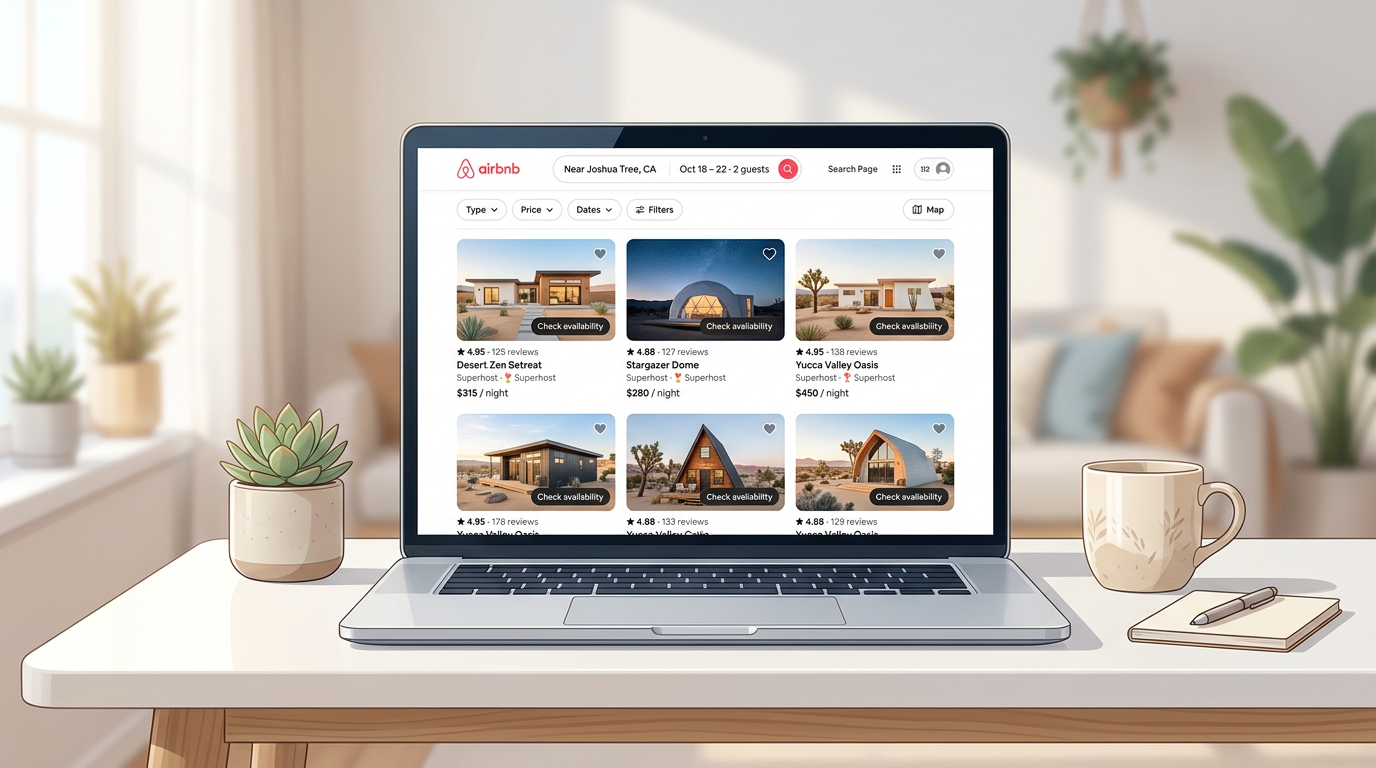
When a guest opens Airbnb and searches for a place to stay in your city, they rarely scroll past the first page of results. Airbnb uses its own algorithm to decide which listings appear at the top, and that algorithm weighs dozens of signals simultaneously: how often your listing converts viewers into bookings, how quickly you respond to messages, how competitive your price is relative to similar properties, whether your calendar is open, how recent your reviews are.
Most hosts treat Airbnb like a static directory. You list your property once, set a price, and wait. But that approach treats Airbnb like a classifieds site rather than what it actually is: a search engine with its own ranking logic. Understanding that logic and working with it is one of the most direct levers you have over your occupancy rate, and it costs nothing beyond your time.
This guide covers the ranking signals that consistently emerge from platform documentation and host experience, and gives you a practical checklist for each one. Airbnb does not publish a full specification for its algorithm, so any analysis of it — including this one — reflects current understanding rather than certainty.
What “Airbnb SEO” Actually Means
The term “Airbnb SEO” gets used loosely. It is worth clarifying what it does and does not mean before getting into tactics.
Traditional SEO (search engine optimization) is about ranking in Google or other external search engines. “Airbnb SEO” refers specifically to your listing’s position within Airbnb’s internal search results when guests filter by location, dates, and trip type. The two are related — Airbnb listing pages can appear in Google results for destination queries — but the ranking signals are fundamentally different.
Inside Airbnb’s search, your position is determined by a combination of factors across roughly four categories:
| Category | What Airbnb measures | Typical speed of impact |
|---|---|---|
| Guest experience signals | Booking conversion rate, overall rating, review recency, response time | Weeks to months (reviews build slowly) |
| Listing quality signals | Content completeness, amenities listed, photo quality, accuracy | Days to weeks (edits index quickly) |
| Availability and pricing | Calendar openness, minimum stay settings, competitive rate vs. market | Near-immediate (price changes show almost instantly) |
| Operational reliability | Cancellation rate, Instant Book status, host account standing | Immediate to cumulative |
Key point: Several guides emphasize this — ranking is not a single lever you can pull. It emerges from how your listing performs across all of these dimensions simultaneously. Improving one area while neglecting the others gives you partial gains at best.
Of the four, pricing is the fastest lever. A rate adjustment can shift your search position within hours because it directly affects how you sit relative to comparable listings. This makes pricing the most actionable signal on a day-to-day basis, and the one most worth thinking about with search position in mind, not just revenue.
For a fuller picture of how these signals combine into a ranking score, Homesberg’s how the Airbnb algorithm works guide covers the mechanics in detail, drawing on data from over 2 million search observations.
Your Title and Description: Keywords Inside Airbnb’s Search
Airbnb’s search functions like a keyword-aware engine. When a guest searches “pet-friendly cabin with hot tub near Asheville,” the algorithm scans listing content for relevance. Your title and description are the primary places that relevance is established.
Title
Airbnb gives you 50 characters for your title. That is not much, so every word should earn its place. Avoid openers that consume characters without adding signal: “Beautiful,” “Charming,” “Cozy,” or “Amazing” tell the algorithm very little and fail to differentiate you in results.
Instead, lead with a specific feature plus location context:
- “Sunny studio with fast WiFi, 5 min to Metro”
- “Pet-friendly cabin near hiking trails and lake”
- “Designer loft, private terrace, city center”
The title appears alongside your first photo in search result thumbnails. Together, they determine whether a guest clicks at all. A high click-through rate is itself a positive signal to the algorithm.
Description
Use all available characters in your description. Go beyond feature lists and connect amenities to the guest experience: who this property works best for, what the neighborhood offers, what makes a stay here different from the next listing on the page.
Lead with the most relevant angles for your target guest: proximity to transit, standout amenities, type of trip (romantic weekend, remote work setup, family-friendly layout). Do not simply repeat your title in the first line.
Avoid generic filler that every listing could use. “Great location” with no specifics, “fully equipped kitchen” without naming what’s actually there, or “guests love it” without evidence are phrases that do not help either the guest or the algorithm.
Photos: Your Click-Through and Conversion Driver
 The first photo is the single most influential visual asset your listing has. This comes up consistently across every guide covering Airbnb optimization, and for good reason: the cover photo is what guests see before they click. If it does not stop the scroll, your description, amenities, and pricing are never evaluated.
Requirements for a strong cover photo:
- Bright, natural light where possible (flash-heavy photos read as staged and less inviting)
- Shows the most distinctive feature of your space: the view, a standout room, an outdoor area, or a unique design element
- Professionally composed, not a fish-eye shot or a room mid-clean
- Honestly representative — overpromising with photography leads to lower guest satisfaction scores and weaker reviews
Photo volume matters too. Complete listings with 20 or more high-quality photos consistently outperform listings with 8 to 10 photos in terms of conversion rate. Every room should be shown: interior rooms, the exterior, neighborhood context, and any standout amenities (hot tub, dedicated workspace, fireplace, pool).
A note on photography investment: professional photography for a short-term rental typically pays back in higher booking rates within a few weeks of a well-trafficked listing. If budget is a constraint, a modern smartphone in good natural light, with a wide-angle lens clip, gets you much of the way there.
Amenities: Matching the Guest Filter
Airbnb’s search includes guest-facing filters for amenities: workspace, pool, pets allowed, parking, washer, kitchen, and many others. When a guest applies a filter, listings that do not have that amenity checked disappear from results entirely, regardless of every other quality signal. What matters most: Failing to check “dedicated workspace” means you do not appear when remote workers filter for it, even if a proper desk is clearly visible in your photos.
Review your amenity checklist against what your property actually offers. Common gaps that hosts miss:
- High-speed WiFi (list the actual speed if you know it — guests searching for remote work are often comparing this number)
- Dedicated workspace as separate from a dining table or coffee table
- Parking (free or paid; specify which)
- Accessibility features (step-free access, grab rails, wide doorways, roll-in shower)
Airbnb’s accessibility features filter is worth specific attention. Listing what your property genuinely offers here opens a search segment that many hosts ignore, and it serves guests who have few other options.
Avoid the opposite problem: checking amenities you do not actually have. Inaccurate listings generate complaints in reviews and can damage your overall rating.
Pricing: Competitive Position and Search Ranking
Most pricing guides focus on revenue: maximize your rate when demand is high, fill empty nights when demand is low. That framing is incomplete for Airbnb hosts, because price does not just affect what you earn per booking — it affects whether guests see you at all.
The underlying relationship looks like this: Revenue = Visibility x Conversion Rate x Nightly Rate You can have the right rate for your market, but if your listing is buried on page three of search results, very few guests will ever see it. And price is one of the fastest signals the algorithm uses to decide where you appear. Pricing significantly above comparable listings in your market reduces your conversion rate, which then reduces your search position. Pricing too low leaves revenue behind. The goal is to find the rate that keeps you competitive in search while still earning what your property is worth — a balance that shifts constantly as demand, events, and competitor behavior change.
This relationship between price and visibility is not guesswork. Homesberg analyzed over 2 million Airbnb searches and found a consistent pattern: lower prices strongly correlate with higher search positions. Airbnb’s own engineering research confirms the directional signal: when their team looked at the gap between model-recommended listings and actually-booked listings, they observed that guests consistently chose the cheaper option. Their natural response was to sort results by price. It reduced booking rates. The conclusion from their own data: price alone does not fully explain guest preferences. It is the fastest-responding variable in the ranking equation, but it operates alongside photos, reviews, and listing quality. Discount without substance gets clicks without bookings.
This is the idea behind search-aware pricing: choosing your rate with explicit awareness of how it affects your search position, not just your revenue per booking. A host using search-aware pricing asks not only “what should I charge tonight?” but also “where does that rate place me in search results, and is that where bookings happen in my market?”
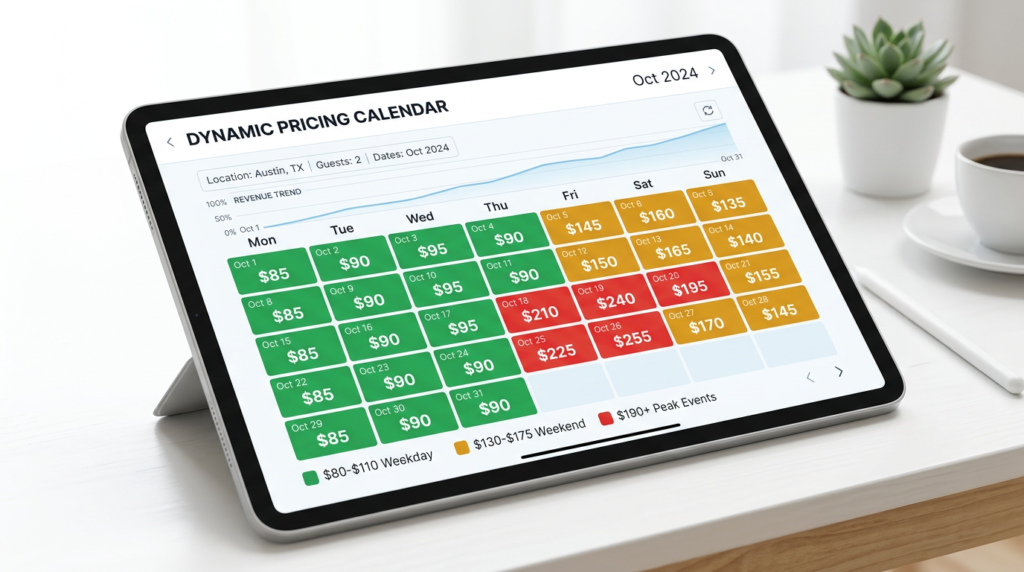
Static pricing (one rate year-round) makes this balance impossible to maintain. Demand fluctuates week by week based on local events, school holidays, weather, and competitor behavior. A fixed rate appropriate for peak season leaves bookings on the table in shoulder months; a rate calibrated for low season surrenders revenue when demand rises.
Dynamic pricing adjusts your rate automatically to reflect current market conditions — but search-aware dynamic pricing goes a step further, connecting rate decisions to live search ranking data so you can see how a price change actually affects your position. Homesberg’s engine is built on this principle: it tracks market demand and competitor behavior and adjusts pricing with visibility as part of the equation, not an afterthought. You can read more about how this works in the search-aware dynamic pricing guide.
Curious where your listing stands in search right now? Homesberg tracks your exact Airbnb search position for any date range, with the same filters guests actually use. Sign up and check your ranking in minutes.
Calendar, Availability, and Minimum Stay Settings
Airbnb surfaces listings with open availability to guests searching specific dates. The principle is simple: if you block dates you could accept, you do not exist in those searches.
Minimum stay settings are where many hosts accidentally cut themselves out of search. If you require a 5-night minimum but guests in your market typically search for 2 to 3 nights, your listing will not appear in the majority of searches. Matching your minimum stay to actual booking patterns in your area is one of the clearest visibility levers available.
Beyond minimum stay: calendar activity itself is a signal. Regular updates — adjusting pricing, opening or closing dates, updating availability — indicate an active, managed listing. Listings that go untouched for weeks tend to lose ground to actively maintained ones. This does not mean making arbitrary changes, but it does mean checking in on your calendar regularly rather than setting it once and forgetting it.
New listings also benefit from Airbnb’s new listing boost, which temporarily increases visibility for recently published listings. Homesberg has a detailed breakdown of how the Airbnb new listing boost works and how to make the most of it during that window.
Instant Book and Response Rate
Airbnb’s algorithm favors friction-free booking. Instant Book listings do not require host approval before a booking is confirmed, and Airbnb treats them more favorably in rankings because they provide a better experience for guests searching with specific dates in mind.
If guest screening concerns you, Instant Book can be configured with requirements: verified government ID, positive review history, agreement to your house rules. These conditions still allow instant confirmation while giving you some filter on who can book.
Response rate and response time are tracked metrics. Listings with a high response rate (95% or better) and fast response time (under one hour) rank better than listings with gaps in their communication record. Response rate is also one of the four criteria for Superhost status, so there is a compounding benefit to staying on top of messages.
Automating initial responses keeps your response time low even during busy periods or when you are away from your phone. The Airbnb app’s quick-reply features, or third-party channel management tools, can handle first-contact messages while you prepare a more detailed follow-up.
Reviews, Ratings, and the Guest Favorite Badge

Reviews are a compounding asset in Airbnb’s algorithm. Early in a listing’s life, they are hard to accumulate and have outsized importance. Once you have 15 to 20 strong reviews, they create a self-reinforcing cycle: better ranking leads to more bookings, which generates more reviews, which strengthens ranking further.
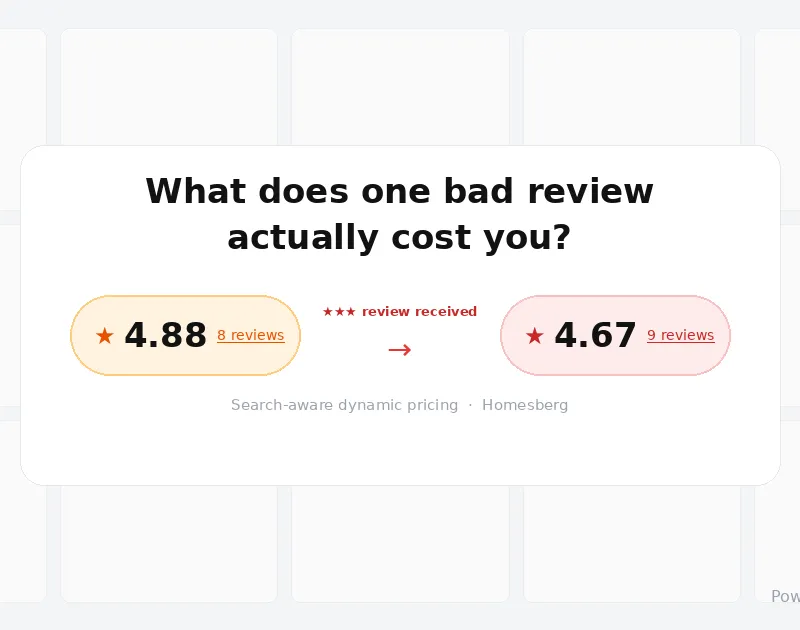
Airbnb weights both the quantity and recency of reviews. A listing with 60 reviews from two years ago can be outranked by one with 25 reviews from the past six months, if the recent reviews are consistently high-quality. Maintaining guest experience standards consistently over time matters as much as the initial burst of reviews. Guest Favorite is Airbnb’s badge for listings that consistently deliver high guest satisfaction. It appears in search results and acts as a social proof signal for guests who filter by it. Earning the badge requires sustained high ratings across all subcategories — cleanliness, accuracy, communication, check-in, location, and value — not just a high overall average. Individual subcategory scores matter. Superhost status similarly carries a visible badge that guests can filter by. The criteria: a 4.8 or higher overall rating, a 90% or higher response rate, fewer than 1% host-initiated cancellations, and at least 10 completed stays per year. These thresholds are achievable for most active hosts, and the badge provides a visible credibility signal in both search results and listing pages.
For a detailed breakdown of what it takes to build toward these ratings, Homesberg’s guide on how to become a 5-star Airbnb host covers the operational habits that drive consistent review quality.
Common Mistakes That Hurt Your Ranking
A few patterns come up repeatedly across host experience and competitor guides:
Ignoring the cover photo while tweaking the description
The cover photo determines whether guests click at all. No description, no matter how well-written, gets evaluated if the thumbnail does not stop the scroll.
Setting a “safe” minimum stay without checking booking patterns
A 5-night minimum in a market where most bookings are 2 to 3 nights means near-zero appearances in the most common searches. Check your booking analytics and look at what guests in your area are actually requesting.
Keyword stuffing the title and description
Writing “Airbnb downtown loft best location top amenities modern cozy bright” is not how the algorithm works, and it reads badly to humans. Natural, specific language that accurately describes the property and experience performs better than a list of adjectives.
Assuming a strict cancellation policy improves ranking
There is no direct relationship between cancellation strictness and ranking. A strict policy can reduce conversion rate — guests are less willing to commit when they cannot change plans — and lower conversion rate harms ranking indirectly. The right cancellation policy is the one that balances your revenue protection needs with the booking friction guests experience.
Setting a price without thinking about search position
Pricing too high relative to comparable listings reduces your conversion rate, which reduces your ranking. Pricing too low leaves revenue on the table. Neither end of that spectrum is a good default. The better question is: at this rate, where do I appear in search results, and is that where my target guests are actually booking? Hosts who ask that question consistently outperform those who set a rate once and revisit it quarterly.
Treating the listing as a one-time setup
Pricing, availability, photos, and even descriptions benefit from periodic review. Market conditions shift. Competitor listings change. A listing that was well-optimized a year ago may have drifted relative to its competitive set.
Final Thoughts
Airbnb’s search algorithm is not fully documented, and any guide about it reflects current understanding rather than certainty. What is consistent across host experience and platform behavior: listings that convert well, are priced competitively, maintain strong and recent reviews, and stay operationally reliable tend to outperform those that don’t — all else equal.
Airbnb SEO is not a one-time fix. It is an ongoing practice: checking your market position, keeping your calendar active, responding promptly, maintaining guest experience standards, and adjusting pricing to reflect current demand. Of all of those, pricing is the one you can act on today and see results within hours. Making that pricing decision with search position in mind — not just revenue — is what separates hosts who fill their calendar from those who wait for bookings to arrive.
If you want visibility into how your ranking shifts when you change pricing or availability, Homesberg’s rank tracker and search-aware dynamic pricing engine are built for that workflow. Try Homesberg for free and see where your listing actually stands in your market.
About Homesberg
Homesberg is a vacation rental analytics and pricing platform built for Airbnb hosts and short-term rental operators. Its core tools include a real-time Airbnb rank tracker that shows where your listing appears in search results for any date range and guest filter, a search-aware dynamic pricing engine that connects rate decisions to live ranking data, and a market benchmarking suite that shows how your listing compares to your competitive set.
All of it is built around one principle: pricing and visibility decisions produce better outcomes when they are informed by what is actually happening in search results, not only by demand forecasts.
Frequently Asked Questions
Does Airbnb SEO affect my Google ranking?
Airbnb listing pages can appear in Google search results for destination queries, but the optimization that helps you rank inside Airbnb is mostly separate from what helps you rank in Google. Strong Airbnb listings do tend to generate more bookings and reviews, which may increase the page’s authority for Google as well, but the two are different systems with different signals.
How quickly do ranking changes take effect?
Pricing changes can affect your search position almost immediately, since they directly influence how competitive you appear relative to similar listings. Review-related changes (earning new reviews, improving subcategory scores) build more slowly, often over several weeks or months. Calendar updates tend to have an immediate effect on which date-specific searches you appear in.
Can a new listing compete with established ones?
Yes, during the early period. Airbnb typically provides a temporary visibility boost to new listings to give them a chance to accumulate bookings and reviews. Making the most of that window — strong photos, competitive pricing, an active calendar, and Instant Book enabled — sets up the longer-term compounding effect.
Does cancellation policy affect search ranking?
Not directly. But a strict cancellation policy can reduce conversion rate (guests are less willing to book if they cannot change plans easily), and conversion rate does affect ranking. The relationship is indirect but real.