What Determines Your Vacation Rental Price?
Setting the right nightly rate is one of the most consequential decisions a short-term rental host makes. Price too high and your calendar stays empty. Price too low and you leave money on the table every night a guest checks in.
The challenge is that vacation rental pricing is not a single-variable problem. Your optimal rate depends on a combination of market conditions, property characteristics, guest behavior, and competitive dynamics that shift continuously.
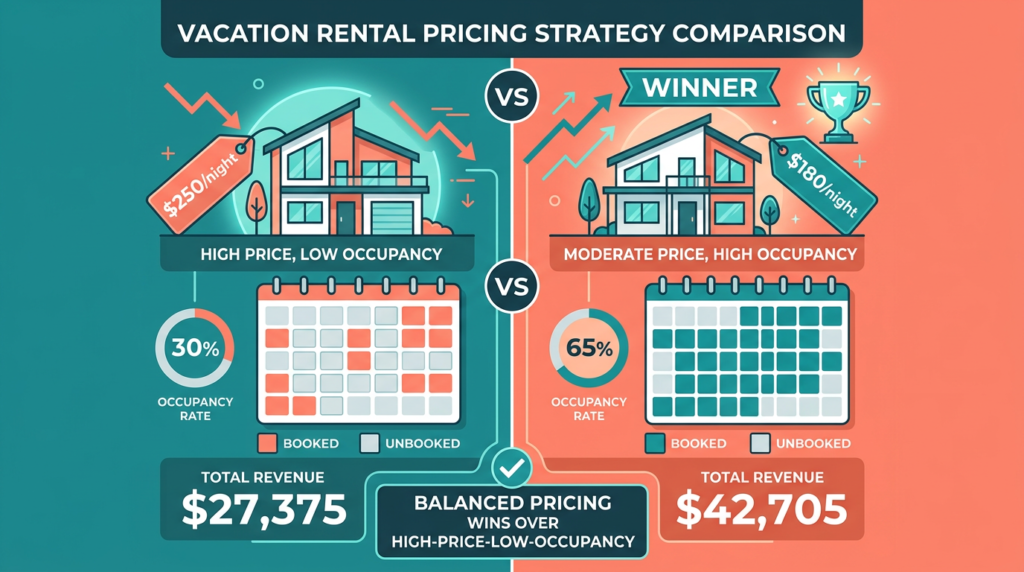
Key point: Several industry guides emphasize that annual revenue, not nightly rate, is the metric that matters most. A property earning $180 per night at 65% occupancy will significantly outperform one charging $250 per night at 30% occupancy. Understanding the factors below is how you get the balance right.
A useful starting point is separating what you can control from what you cannot. If you already own the property, some factors are fixed. Others are entirely within your hands.
| Fixed factors (you work around them) | Actionable factors (you control these) |
|---|---|
| Seasonality and local demand cycles | Nightly rate and pricing strategy |
| Location and neighborhood | Property amenities and presentation |
| Base property size and guest capacity | Guest reviews and response practices |
| Competitive positioning and timing | |
| Search visibility through pricing and listing quality |
This article breaks down both sides, explains how each factor influences your rate and occupancy, and offers a framework for turning them into a working revenue strategy.
Seasonality: The Biggest Swing Factor
Seasonality is the single most predictable pricing lever in vacation rentals. Demand follows patterns tied to weather, school holidays, local events, and travel habits. These patterns differ by market, but they exist everywhere.
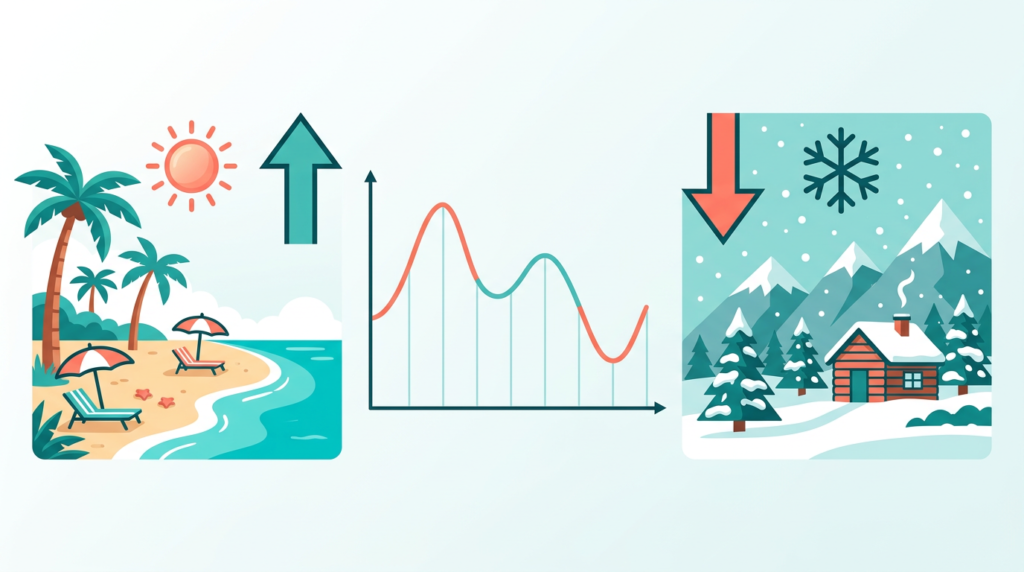
In coastal destinations, summer months can command rates two to three times higher than winter. Urban properties may see steadier demand year-round but still peak during conferences, festivals, or holiday weekends. Ski destinations flip the script entirely, with winter as their premium season.
What matters for pricing:
- Annual demand curves: Map your market’s high, shoulder, and low seasons. Pricing should reflect these tiers, not a single flat rate.
- Day-of-week patterns: In many markets, weekends command a premium. Business-travel cities may see stronger weekday demand.
- Local events and holidays: Concerts, sports events, cultural festivals, and public holidays can create demand spikes that justify significant rate increases.
- Booking window behavior: Some regions see bookings weeks in advance, while others are dominated by last-minute travel. Adjusting price as the check-in date approaches (lead time pricing) is a direct response to this factor.
A host who charges the same rate in August as in February is almost certainly leaving revenue behind in peak season and sitting empty in the off-season.
Homesberg combines seasonality patterns with real-time Airbnb search ranking signals, so you can see not just when demand rises in your market but how your listing’s position in search results shifts as the season changes. That connection between timing and visibility is what makes seasonal rate adjustments land precisely rather than blindly.
Location and Market Context
Where your property sits determines the baseline for what guests are willing to pay. This goes beyond country or city: the specific neighborhood, proximity to attractions, walkability, and even the view from the balcony all factor into perceived value.

Two listings with identical floor plans can command very different rates if one is a five-minute walk from the beach and the other is a 30-minute drive away.
Factors within location that influence pricing:
- Proximity to demand drivers: Beach, city center, ski slopes, conference venues, transit hubs.
- Safety and neighborhood quality: Guests research neighborhoods before booking. Areas with a reputation for safety and walkability can sustain higher rates.
- Local supply density: In areas saturated with rentals, competition compresses pricing power. In low-supply markets, hosts have more room to price up.
- Regulatory environment: Markets with strict short-term rental regulations tend to have lower supply, which can support higher rates for compliant listings.
You cannot change your location, but you can use it strategically. If your property is in a competitive urban market, tight pricing relative to comparable listings matters more than if you are one of five rentals on a quiet island.
Property Characteristics and Guest Capacity
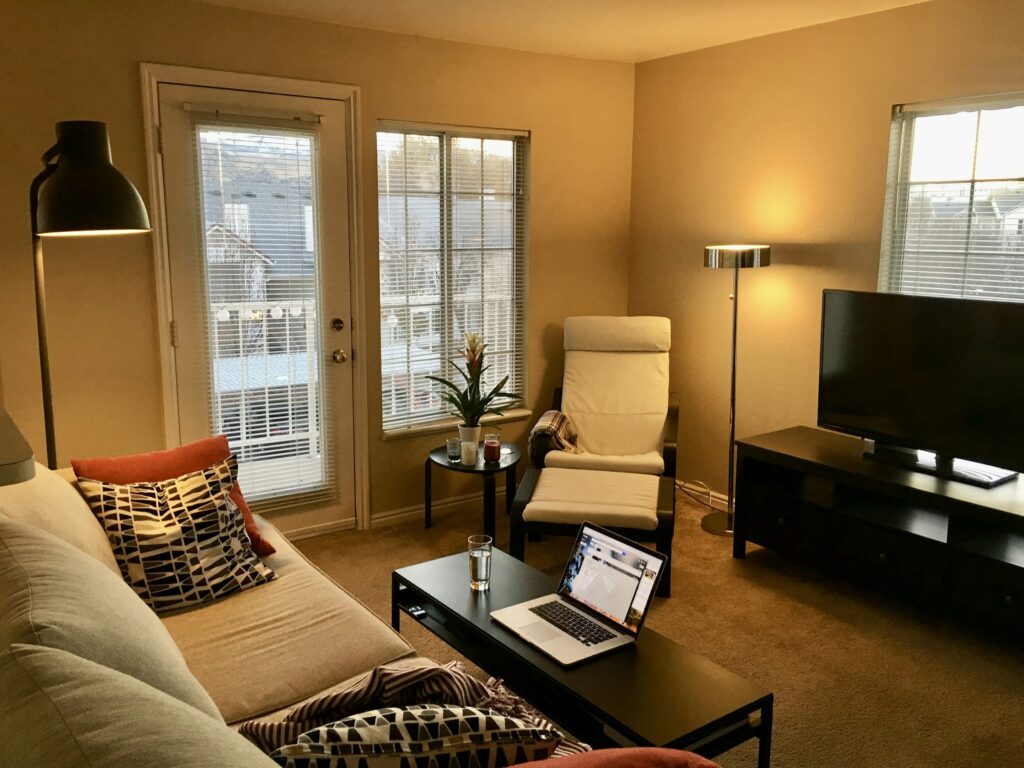
The physical attributes of your listing set the ceiling for what you can reasonably charge. Guests evaluate space, amenities, design, and capacity when comparing options.
Key property-level factors:
| Factor | Pricing impact |
|---|---|
| Bedrooms and sleeping capacity | More capacity generally supports higher rates, up to a point |
| Unique features (pool, hot tub, view) | Can justify a significant premium in leisure markets |
| Modern design and furnishing | Data consistently shows modern aesthetics drive higher booking rates |
| Kitchen and workspace | Important for longer stays and remote workers |
| Parking and outdoor space | Particularly valuable in suburban and rural markets |
| Accessibility features | Broadens your guest pool and can reduce vacancy |
Investing in your property is a long-term pricing lever. Upgrades that improve guest experience tend to compound through better reviews, higher conversion rates, and sustained pricing power.
One practical step is benchmarking your amenity profile against the listings that actually hold first-page positions in your market. Homesberg lets you build a custom search filter that mirrors your property’s bedroom count, capacity, and location, so you can see exactly which features your top competitors offer and how they price around them.
Guest Reviews and Rating Quality
Reviews are one of the strongest signals in short-term rental marketplaces. They influence both your search ranking and the rate guests are willing to accept.
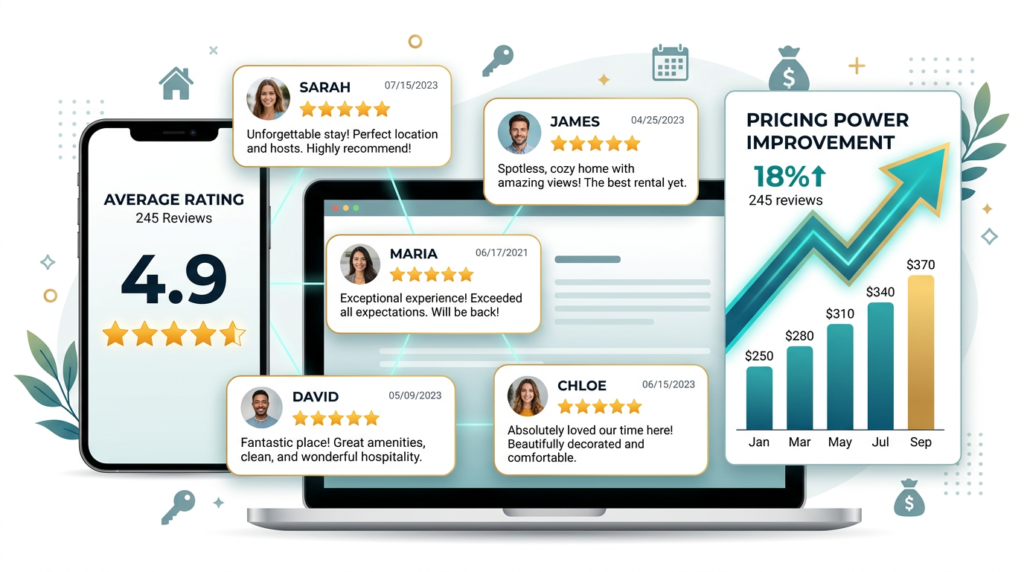
On platforms like Airbnb, listings with higher ratings and more reviews tend to appear higher in search results. This creates a feedback loop: better visibility leads to more bookings, which generates more reviews, which reinforces ranking strength.
For pricing specifically:
- Higher ratings support higher rates. Guests will pay more for a listing with a 4.9 rating and 200 reviews than one with a 4.5 rating and 20 reviews.
- Recent reviews carry extra weight. A cluster of strong recent reviews signals current quality. Stale review profiles may indicate declining relevance.
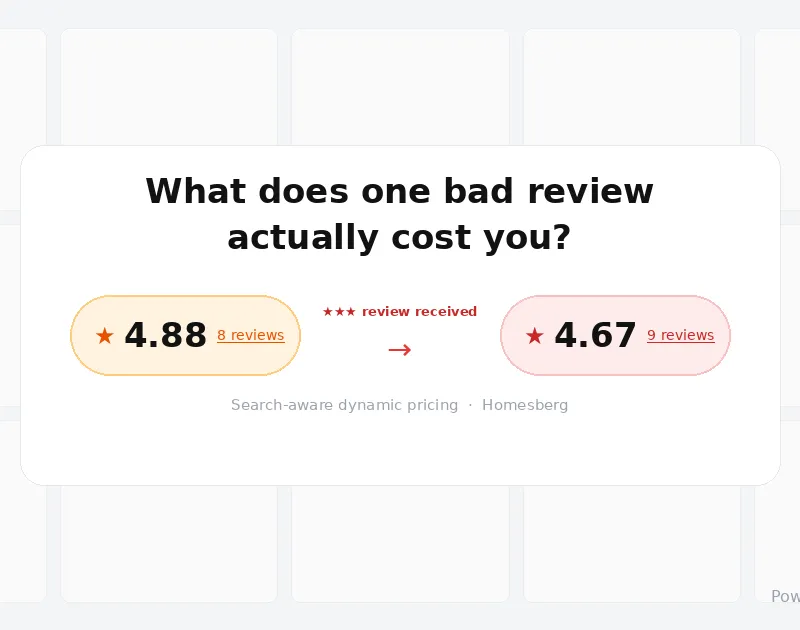
- Negative reviews compress pricing power. Even a few poor reviews can reduce what guests will pay, requiring lower rates to maintain occupancy.
The practical implication is that review management is revenue management. Consistent guest experience, clear communication, and fast issue resolution are investments in your ability to sustain higher prices.
Homesberg’s ranking tracker lets you monitor the first page of Airbnb search results for your market, including your competitors’ ratings, review counts, and how their positioning shifts over time. Knowing where you stand relative to the listings guests actually compare you against is the first step toward closing that gap.
Competitive Positioning and Market Benchmarking
Your price does not exist in a vacuum. Guests compare your listing against others that match their search criteria, dates, and filters. Your competitive set (the group of similar listings a guest sees alongside yours) directly shapes booking probability at any given rate.

Competitive factors that drive pricing decisions:
- Comparable listings’ rates: If three similar properties nearby are priced at $150, $160, and $170, pricing yours at $220 without a clear value differentiator will cost you bookings.
- Competitor occupancy signals: When comparable listings are booking up, the market can support higher rates. When calendars are open, the market is telling you to adjust.
- Booking platform positioning: On search-driven marketplaces, where your listing appears in results directly affects how many guests even see your price. A listing buried on page three has fundamentally different booking probability than one on page one, regardless of how well it is priced.
This last point is worth underscoring. Several industry analyses point out that pricing and search visibility are interconnected. A rate that looks optimal on paper may be suboptimal if it pushes your listing out of the first page of search results. Conversely, a slight rate adjustment can sometimes move a listing from page two to page one, dramatically increasing booking probability.
Understanding your competitive set, not just your costs, is essential for effective pricing.
Demand Patterns and Booking Behavior
Beyond seasonality, shorter-term demand patterns create pricing opportunities that hosts often miss.
- Lead time (booking window): How far in advance guests book varies by market and season. In some regions, strong demand appears weeks ahead; in others, most bookings happen within a few days of check-in. Adjusting prices based on how close the check-in date is can recover revenue from otherwise empty nights.
- Length of stay: Longer stays reduce turnover costs (cleaning, laundry, wear). Offering a modest weekly or monthly discount can improve occupancy without sacrificing profitability.
- Day-of-week demand: Weekend versus weekday patterns differ across markets. Leisure destinations spike on weekends; business-travel cities may see the reverse.
- Last-minute demand: Unfilled nights represent permanent revenue loss. A night that passes unbooked is inventory that cannot be sold later. Reducing price as check-in approaches is often better than letting a night go empty.
The core principle here is that every available night has a time-decaying value. The closer it gets to check-in without a booking, the more it makes sense to lower the rate, because the alternative is zero revenue.
Operating Costs and Profit Margins
Revenue is not profit. Your pricing strategy needs to account for the costs that come with each booking and the fixed costs that persist regardless of occupancy.
Common cost categories:
- Platform commissions: Airbnb, Booking.com, and other channels take a percentage of each booking. This typically ranges from 3% to 15% depending on the platform and fee structure.
- Cleaning and turnover costs: These are incurred with every checkout and can be substantial for larger properties.
- Utilities and consumables: Electricity, water, internet, toiletries, and supplies.
- Maintenance and repairs: Wear and tear increases with occupancy. Budget for regular upkeep and unexpected repairs.
- Insurance and taxes: Short-term rental insurance, local tourism taxes, and income taxes vary by jurisdiction.
A critical insight for pricing: fixed costs (mortgage, insurance, base utilities) are the same whether you book 10 nights or 30 nights per month. Variable costs per booking are typically much lower in proportion. This means that maximizing occupancy, even at a slightly lower nightly rate, often yields more profit than holding out for premium rates with empty nights.
This is exactly why metrics like RevPAL (Revenue Per Available Listing), which divides total revenue by total available nights rather than just booked nights, give a more accurate picture of performance than ADR (Average Daily Rate) alone. You can read more about ADR versus RevPAL and which metric matters more to understand this distinction in depth.
Search Visibility: The Hidden Pricing Factor
Most pricing guides focus on supply, demand, and costs. Fewer discuss the factor that determines whether your listing gets seen at all: search visibility.
On platforms like Airbnb, revenue depends on three variables working together: Revenue = Visibility x Conversion Rate x Nightly Rate You can have the perfect price for your market, but if your listing appears on page five of search results, very few guests will ever see it. Visibility acts as a gateway between demand and bookings.
What affects visibility:
- Listing quality signals: Photos, descriptions, amenities, and content completeness.
- Review strength: Rating, recency, and volume.
- Conversion history: Listings that convert views into bookings at higher rates tend to be shown more.
- Response time and reliability: Hosts who respond quickly and rarely cancel are favored.
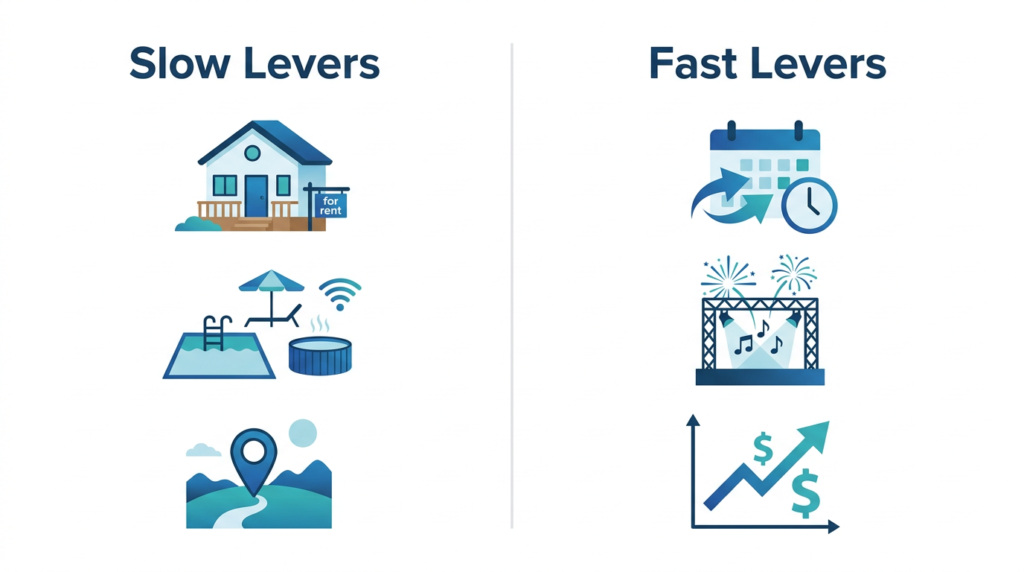
- Price relative to competition: This is the immediate lever. Price can shift your position in search results almost instantly, while the other factors build gradually.
The practical takeaway is that pricing decisions should consider not just “what rate fits the market” but also “where does this rate place me in search results.” A listing with strong fundamentals (great reviews, high-quality photos, reliable hosting track record) has more pricing flexibility because its visibility band is wider. A newer listing with fewer reviews may need to price more competitively to earn first-page placement and build booking momentum.
Homesberg operationalizes this relationship by connecting pricing decisions to real-time search ranking data, so hosts can see exactly how rate changes affect their position in search results.
How These Factors Interact
No single pricing factor works in isolation. The real challenge is managing the interplay between them.
Consider a scenario: a well-reviewed two-bedroom apartment in a competitive coastal market. During peak summer:
- Seasonality supports higher rates.
- Demand is strong, and comparable listings are booking up.
- Competitor rates are elevated, giving room to price up.
- Reviews are strong, supporting a premium position.
The host can price aggressively and still maintain high occupancy. But shift to shoulder season:
- Seasonality depresses demand.
- Fewer comparable bookings mean less market support for high rates.
- Competitors may be cutting prices.
- Visibility becomes more contested as listings compete for fewer guests.
The same listing now needs a different strategy: lower base rate, tighter lead-time adjustments, and possibly promotional discounts to maintain occupancy. The hosts who perform best treat pricing as a continuous process, not a one-time decision. They monitor their market, track competitive positioning, and adjust regularly based on current conditions.
From Manual Guesswork to Data-Driven Pricing
Historically, most hosts set a nightly rate based on intuition, neighbor comparison, or a rough cost calculation, and then left it largely unchanged. This approach leaves significant revenue on the table because it cannot respond to the constant changes in demand, competition, and visibility that define short-term rental marketplaces.

Dynamic pricing addresses this by continuously adjusting rates based on live market data. The core inputs typically include:
- Seasonality mapping: Historical and forward-looking demand patterns for your specific market.
- Competitor benchmarking: Real-time pricing and occupancy of comparable listings nearby.
- Lead time adjustments: Rate changes based on how far out the booking date is and current booking pace.
- Event and calendar awareness: Spikes from local events, holidays, and market-specific demand drivers.
The shift from static to dynamic pricing is not about removing the host from the equation. The best approaches let hosts set their base price (the year-round average they are comfortable with) and then optimize around it, respecting minimum and maximum boundaries.
Homesberg’s dynamic pricing engine works on this principle, using three core components: seasonality, similarity-based competitor benchmarking, and lead time sensitivity, all powered by proprietary market data collected daily across millions of listings.
Final Thoughts
Vacation rental pricing is shaped by forces that range from broad market conditions to the specific characteristics of your listing and its competitive context. The factors that matter most:
- Seasonality creates the biggest rate swings and is the most predictable.
- Location and property quality set your baseline and ceiling.
- Guest reviews compound into pricing power over time.
- Competitive positioning determines what the market will bear at any given moment.
- Search visibility decides whether guests even see your listing at the price you set.
- Operating costs define where profit actually lives.
The question is not just “what should I charge tonight?” It is “what combination of rate, occupancy, and positioning maximizes my revenue over the full year?”
Hosts who treat pricing as a passive, set-it-and-forget-it decision will consistently underperform those who engage with the data and adjust regularly. Whether you do this manually or with the support of a dynamic pricing tool, the principle is the same: know your market, track your competition, and make pricing decisions with full situational awareness.
About Homesberg
Homesberg is an all-in-one vacation rental management platform built around the features hosts truly need: self-reliant market data collection, an Airbnb ranking tracker, a robust dynamic pricing engine, and seamless integrations with all major channels. No more juggling multiple tools or paying for underutilized features.
Sign up now to start your free trial and see where your pricing stands in your market.