What Is the True Cost of a Negative Review on Airbnb?
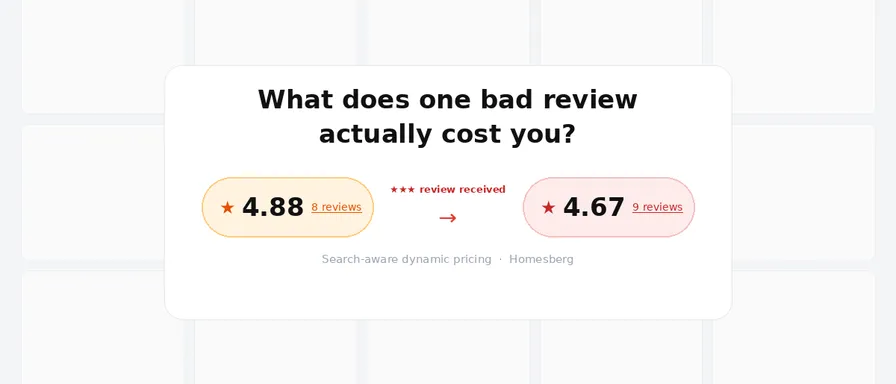
On April 6, a listing that had gathered a 4.88 rating from 8 reviews over several months received a single 3-star review.
By the end of that day its rating stood at 4.67. A 0.21-point drop. It wasn’t totally justified. It was based on events beyond the control of the host or the attributes of the listing. If you are hosting long enough, possibly you have been there before. It happens eventually.
The instinct is to shake it off and move past. Leave a polite response (you definitely should, to influence future guests’ first impressions), hope the next guest is kinder, keep going.
But the calendar didn’t move on. The ranking didn’t wait. Airbnb had already read the new score and repositioned the listing accordingly, across every upcoming search, every date range, every potential guest looking in that area. Because the Airbnb search algorithm is not sympathetic to your intentions or care about the fact that it was beyond your control. Instead it is ruthlessly optimised for one thing only: conversion. And social proof and trust are the backbone of it.
The question isn’t how bad the review felt. The question is what it cost — and what it takes to get back to square one.
What a Rating Drop Actually Triggers
Most hosts think of their rating as a scorecard updated occasionally. What it actually is, is arguably the most important parameter of what Airbnb itself calls the “reservation possibility score” — a live ranking input that Airbnb reads and evaluates continuously.
When your rating changes, Airbnb doesn’t wait for a weekly recalculation. The algorithm recalibrates your position immediately, measuring you against every competing listing in your market. A listing that sat comfortably in the top tier at 4.88 is now being evaluated as a 4.67, and in markets with hundreds or even thousands of listings, a 0.21-point drop in your rating can move you by 0.35 percentile points in terms of review average.
Your price doesn’t change. Your photos don’t change. Your amenities don’t change. But your rank does — because the algorithm has updated its assessment of your conversion probability. And a lower conversion probability means lower placement, across every date range, every search query, every guest who looks in your area from that point forward.
This is not a temporary flag. It is a repositioning.
The Data: Two Searches, Two Different Disasters
To understand what the repositioning actually looked like, here are two searches Homesberg tracked for this listing, seen from two completely different guest perspectives. A small window into what was happening across its entire calendar.
Search 1: April 11-14, 1km radius, 6 guests
A proximity-based search in a market of 85-100 listings at that time. Before the review, the listing was at rank 8, page one, pricing above the first page average. After the review it fell to page two. It stayed there. Even with a 20% discount applied the listing remained vacant across a 3-night window. Minimum cost: $167 per night, 3 nights. That is $500 in a single search window.
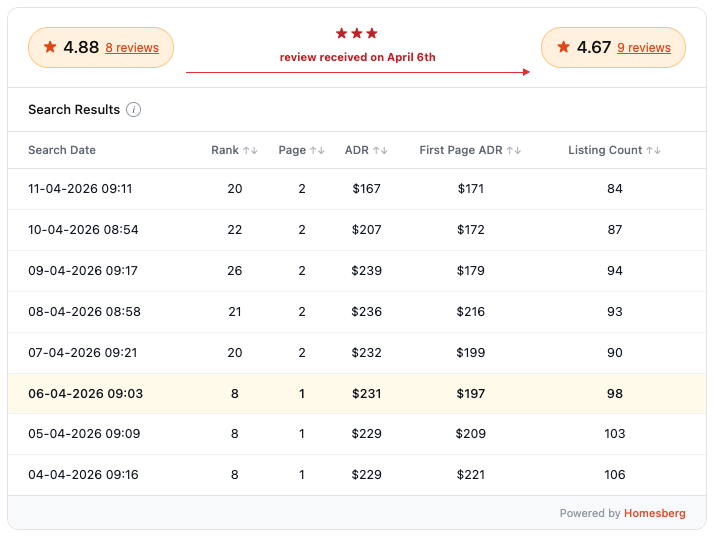
This listing held a strong page 1 position (rank 8) for days, then slipped to page 2 (rank 20–26) immediately after the April 6th review — visible proof of Airbnb’s review-to-rank sensitivity.
Search 2: April 19-21, neighbourhood search, 6 guests
The same listing, this time found through a location name search across a market of nearly 600 listings. Here the drop was sharper: from pages 6-8 before the review to pages 12-14 after. Approximately 90 ranks. Five pages.
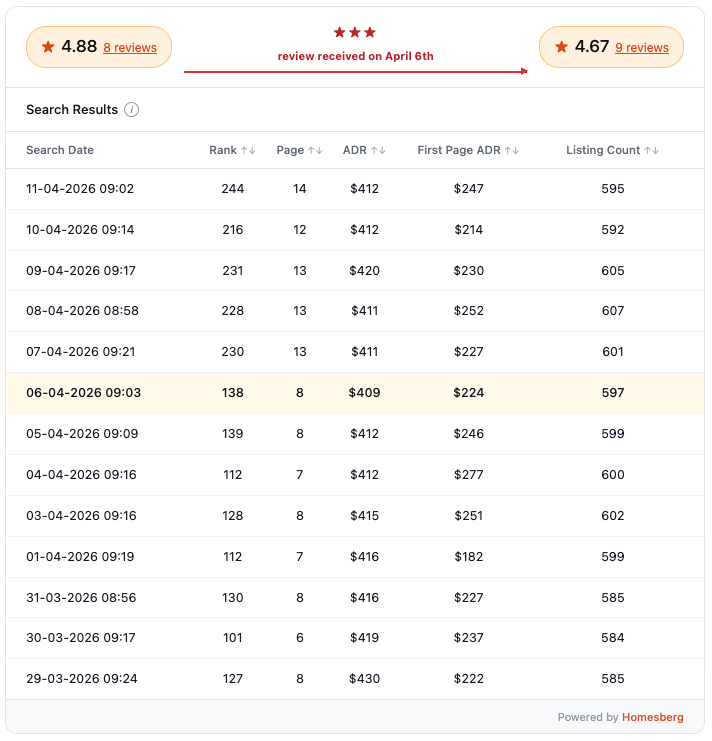
After a 3-star review landed on April 6th, this listing’s rank fell from page 7 (rank 112) to page 14 (rank 244) within a week — a dramatic drop Homesberg captured in real time.
This is not two unlucky date ranges. This is the same listing, hit by the same review, across two different ways a guest might search for it. Multiply that across every search type, every upcoming date, every guest who looked in that area after April 6 — and the situation becomes considerably more costly.
The Math Most Hosts Never Do
$500 is the minimum cost of a single 3-night vacancy in one search window. It is not the cost of the review.
Part of what made this swing so sharp is the listing’s review count. With only 8 reviews before the drop, each new review carries significant weight. A listing with 80 reviews absorbs the same 3-star far more gently.
But the broader point holds regardless of review count. Airbnb rankings are not a general score. They are date-specific, market-specific, competition-specific, amenity-specific and guest-search-specific. What this listing experienced across two searches on two different dates is a version of what every listing experiences after a rating change — the scale differs, but the mechanism is the same, and it happens in real time, across the calendar for every guest search into the future.
The math across a full calendar is uncomfortable. Twenty to thirty open booking windows over 90 days. Even a modest impact on a third of those adds up to several thousand euros in direct losses — before accounting for the longer recovery runway of 16 consecutive five-star reviews needed just to get the rating back to where it was.
If you want to understand what actually drives better reviews — response time, guest communication, expectation-setting — our official partner Hospitable has a solid breakdown here:
—> How to Manage Vacation Rental Reviews: 5 Best Practices from Hosts
What You Actually Have to Influence Your Ranking
When this listing slipped, the host discounted to recover the ranking. It worked partially. But not enough — and the timing was the problem.
Airbnb’s algorithm combines two things to determine your position: the reservation possibility score it assigns to your listing based on reviews, conversion history, and every factor it measures, and the price you set. Airbnb controls the score. The host controls the price. That combination determines where you rank.
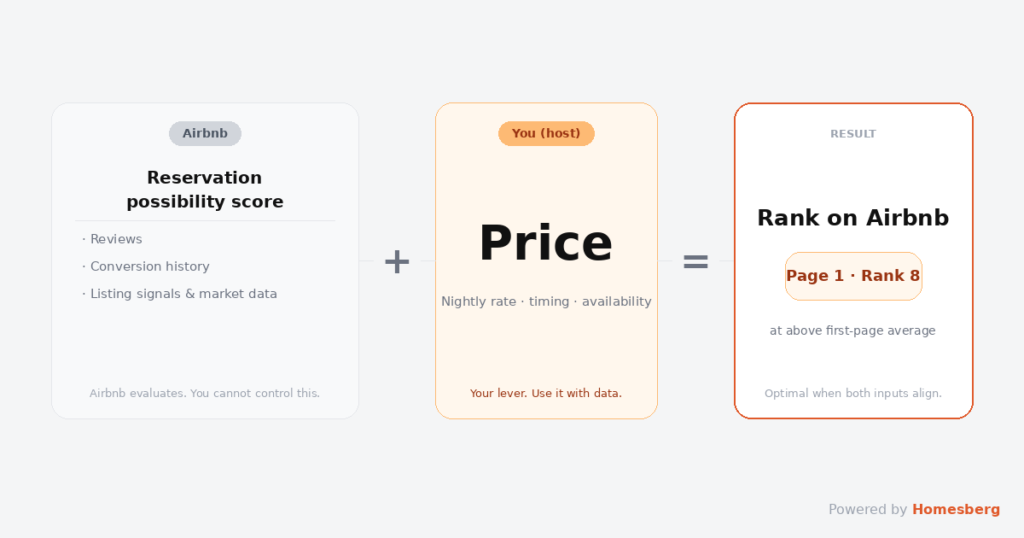
Airbnb controls the score. You control the price. Your rank is the result of both. Homesberg · Search-aware dynamic pricing.
At 4.88, this listing had pricing power. It was sitting on page one asking above the first page average — the score was strong enough to carry that premium. After the review, the score dropped and the pricing power went with it.
The host discounted. But the first page average was moving down at the same time, last minute price wars in a saturated market. The window to recover with a price move was open on April 7. By the time the discount reached the right level, that window had narrowed.
Airbnb rankings are highly sensitive to price. They respond in seconds. Act early, act with data. Wait, and the target moves.
Price is the lever. But only when used before the gap becomes too wide to close.
Why Most Hosts Never See This Coming
The $500 vacancy is visible. The empty calendar days are visible. What is not visible in most tools hosts use daily is the rank.
Most revenue management tools don’t factor in your reviews at all, let alone your rankings. Location, bedroom count, and past reservation data. That is the full picture they work with. Not your rating, not your badge, not your conversion history.
What they give back in return is complexity. Competitive sets, booking latency curves, abbreviations that require a manual to decode. Tools built to look sophisticated rather than to answer a simple question.
The question is simple. Where does your listing appear when a guest searches for your dates, in your area, for your capacity? And is that position working for you or against you?
You can have the best listing on Airbnb. But you cannot sell it if Airbnb is not showing it in the right place.
Track your rank. Understand what moves it. That is where it starts.
Start tracking your Airbnb ranking with Homesberg → Handle guest communication on autopilot with Hospitable →