Vacation Rental Pricing Strategies: The Host’s Complete Revenue Playbook

The One Metric That Changes How You Think About Pricing
Most hosts instinctively optimize for the highest nightly rate. That instinct is understandable but often counterproductive. The number that actually determines how well your property performs is annual revenue, not nightly rate.
Consider two properties in the same market:
- Property A charges $200 per night and runs at 45% occupancy: roughly $32,850 per year.
- Property B charges $155 per night and runs at 75% occupancy: roughly $42,506 per year.
Property B earns about 30% more despite a lower nightly rate. The math favors occupancy until a certain point, after which rate increases add real value. Finding that balance is what pricing strategy is about.
This guide walks through each strategy that shapes that balance: from setting your base rate to handling seasonal swings, event spikes, last-minute gaps, and the ongoing loop that keeps your pricing calibrated to a changing market.
Step 1: Set a Grounded Base Rate
Your base rate is not what you want to earn. It is what your market will support for a property like yours.
How to calibrate your base rate
Start with a competitive analysis. Find 10 to 15 listings in your area that match your property on the dimensions guests actually compare: bedroom count, location distance, amenity tier (pool, parking, pet-friendly), and star rating. Look at what they charge on a typical midweek night outside peak season. That cluster gives you a market corridor.
Your base rate should reflect where your property sits within that corridor:
| Market position | Base rate adjustment |
|---|---|
| Fewer amenities, newer listing, no reviews | 15–20% below corridor midpoint |
| Comparable amenities, moderate review profile | At or slightly below midpoint |
| Strong reviews (4.8+), standout features, or high demand | At or above corridor midpoint |
Key point: Your cost structure (mortgage, insurance, utilities) tells you your floor, but the market tells you what guests will pay. Price from the market down to your costs, not the other way around.
For new listings specifically, pricing 15–20% below your eventual target market rate for the first handful of bookings is a deliberate investment. Early bookings build reviews, and reviews unlock the ability to raise rates.
Step 2: Static vs. Dynamic Pricing
Once you have a base rate, the next decision is whether to hold it steady or let it move.
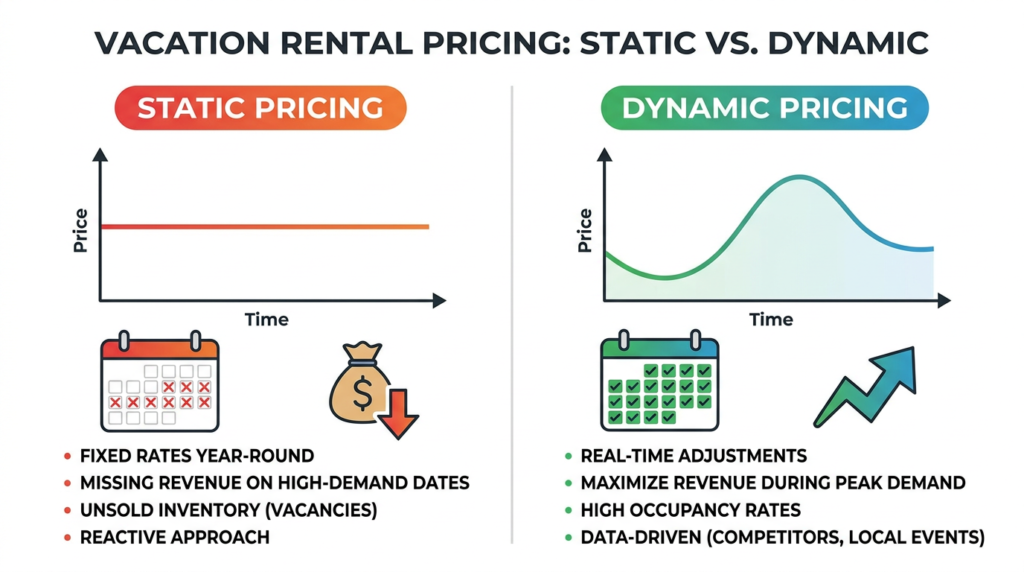
Static pricing means setting a rate and largely leaving it alone, perhaps with a seasonal tier or two. It is simple to manage, but it systematically misses revenue on high-demand dates and bleeds bookings on slow ones.
Dynamic pricing adjusts rates continuously based on market signals: competitor occupancy, local demand trends, booking pace relative to historical norms, upcoming events, and lead time. The premise is straightforward: if demand for your dates is rising, your rate should too, and vice versa.
The core mechanics of dynamic pricing:
- Floor price: The minimum you will accept per night. This protects margins and acts as a quality filter on the guest pool.
- Ceiling price: A cap that prevents the algorithm from pricing you out of contention during demand spikes you have not anticipated.
- Base rate: The anchor the system adjusts around, driven by your competitive research.
- Rule layers: Manual overrides for events you know about, seasonal minimums, or days you never want to discount (peak holidays, for example).
The practical question is whether to manage dynamic pricing manually or with a tool. Manual management is viable for a single property if you are willing to check market data a few times per week. For most hosts, dedicated pricing software handles the monitoring and adjustments automatically.
Airbnb offers a built-in Smart Pricing feature, but many hosts find it conservative, often pushing rates lower than the market warrants. Third-party tools tend to outperform it by incorporating richer data sources: competitor calendars, local events, and booking-pace signals that the platform’s tool does not fully factor in. Homesberg is one such tool, built specifically for Airbnb hosts and designed around search visibility as a first-class input alongside demand signals, so pricing decisions account for where your listing actually appears in search results.
Step 3: Seasonal Pricing Tiers
Every market has a demand rhythm. The host who charges the same rate in August as in November is leaving money on the table in peak season and competing unnecessarily during slow periods.

Photo: Unsplash
The standard seasonal framework uses three tiers:
| Season tier | Demand context | Rate guidance |
|---|---|---|
| High season | Peak travel for your market type | 20–50% above base rate |
| Shoulder season | Moderate demand, competitive environment | Base rate, or a modest 10–15% premium |
| Low season | Reduced demand; occupancy matters more than rate | 10–20% below base rate |
What counts as “high season” depends entirely on your market. Beach markets peak in summer; ski destinations flip this completely. Urban properties with conference demand may see mid-October outperform August. Study your specific market rather than applying generic seasonal assumptions.
Day-of-week patterns layer on top of seasonal tiers. In leisure markets, Friday and Saturday nights typically command 20–50% higher rates than weekdays. Business-travel destinations may see the reverse: strong weekday demand with weaker weekends. Setting weekend differentials as a standing rule (not a manual adjustment each week) is one of the easiest automation wins available to hosts.
Step 4: Event-Based Pricing
Local events create demand spikes that appear and disappear quickly. Music festivals, major conferences, sports tournaments, university graduations, and public holidays all generate concentrated demand that the market cannot absorb at base rates.
Several guides emphasize this point: event-driven pricing is where hosts most consistently leave the largest amounts of money on the table, because the window to capture it is short and the demand signal is often invisible until it is too late.
A practical approach to event tracking:
- Check your city’s convention center calendar quarterly.
- Follow local tourism board social media accounts.
- Search your city and upcoming month for scheduled events when reviewing pricing.
- Set calendar reminders to review rates for known recurring events (annual festivals, sports seasons, graduation dates).
Event pricing premiums vary significantly by event scale:
- Major national events (large music festivals, championship tournaments): 2x to 5x base rate is defensible if your market has constrained supply.
- Mid-scale events (regional conferences, university events, local marathons): 50–100% premium is typical.
- Local recurring events (weekly markets, smaller concerts): 15–30% uplift may be appropriate.
One important caution: event pricing is more speculative than seasonal pricing. Not every event drives lodging demand equally. An outdoor concert may spike demand; a business conference in a convention center a mile away may not. Track what actually books at elevated rates after events, and refine your multipliers over time.
Step 5: Length-of-Stay Strategy
Not all bookings are equally profitable. A one-night booking and a seven-night booking at the same nightly rate produce very different outcomes once you account for cleaning costs and turnover.
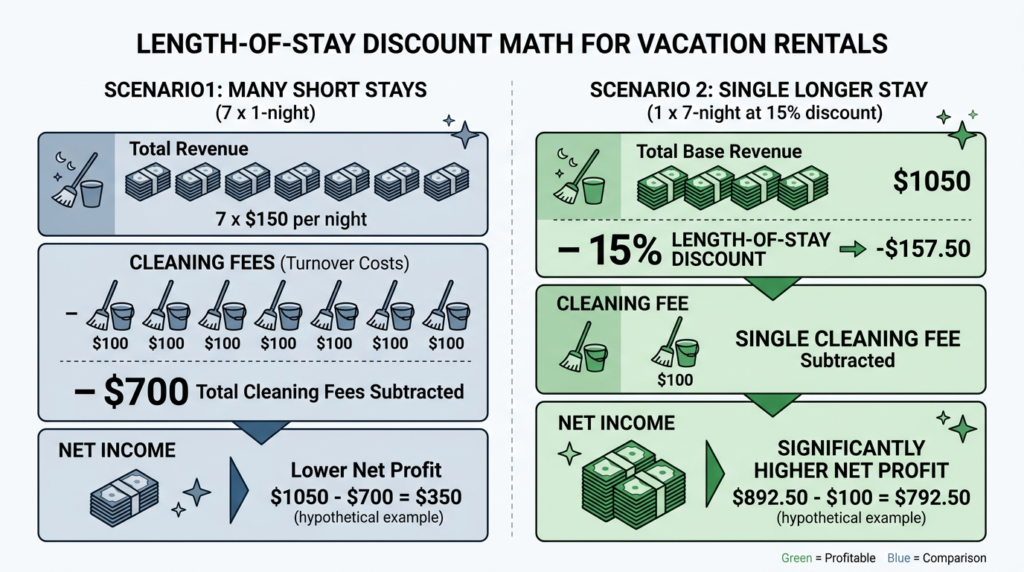
The math is straightforward. Assume a $150/night listing with $100 cleaning fees:
- Seven one-night stays: $1,050 gross minus $700 in cleaning fees equals $350 net.
- One seven-night stay at a 15% discount: $892.50 gross minus $100 cleaning fee equals $792.50 net.
The longer stay at a 15% discount produces more than double the net income from the same seven nights.
This is why length-of-stay discounts are not generous gestures; they are a financially sound strategy. Common discount structures:
| Stay length | Typical discount |
|---|---|
| 7+ nights (weekly) | 10–15% |
| 28+ nights (monthly) | 25–35% |
There are important exceptions. During peak demand periods, especially when your market is filling up ahead of a high-demand date, accepting a long stay at a discount can block higher-revenue short bookings. Length-of-stay discounts work best during shoulder and low seasons, when the alternative to a discounted long booking is often vacancy.
You can also use minimum stay rules strategically. Requiring a two or three-night minimum around weekends prevents one-night bookings from blocking a longer stay, while still capturing weekend travelers.
Step 6: Lead Time and Pacing
Pacing refers to how your booking accumulation compares to what your market typically shows at the same point before a given date. It is one of the clearest real-time signals available for pricing decisions.
The logic works in both directions:
- If your calendar is filling faster than the market norm for a future date, that date has stronger-than-expected demand. Pricing should move up.
- If comparable listings around you are booking up while your dates remain open, you are likely priced above what the market will bear at that moment. A rate adjustment can recover occupancy before the date passes.
Lead time pricing is a specific application of pacing logic. As check-in approaches:
- Far out (60+ days): Charge a slight premium for guests who book early. They are locking in revenue; they should pay for the certainty.
- Mid-window (14–60 days): Standard market rate. Monitor competitor availability and adjust if the market is moving.
- Short window (0–14 days): Empty nights lose value quickly. Reducing the rate to attract last-minute bookings is almost always better than letting a night pass unbooked. Zero revenue from an empty night cannot be recovered.
The key discipline here is not to hold out for your target rate on short-notice dates that are unlikely to fill at that rate. A reduced but filled night outperforms an empty one.
Step 7: Gap-Night Filling
Orphan nights are single vacant nights between two reservations. Because they can only be booked as a standalone one-night stay, they are often the hardest inventory to sell, and they tend to go unbooked at standard rates.
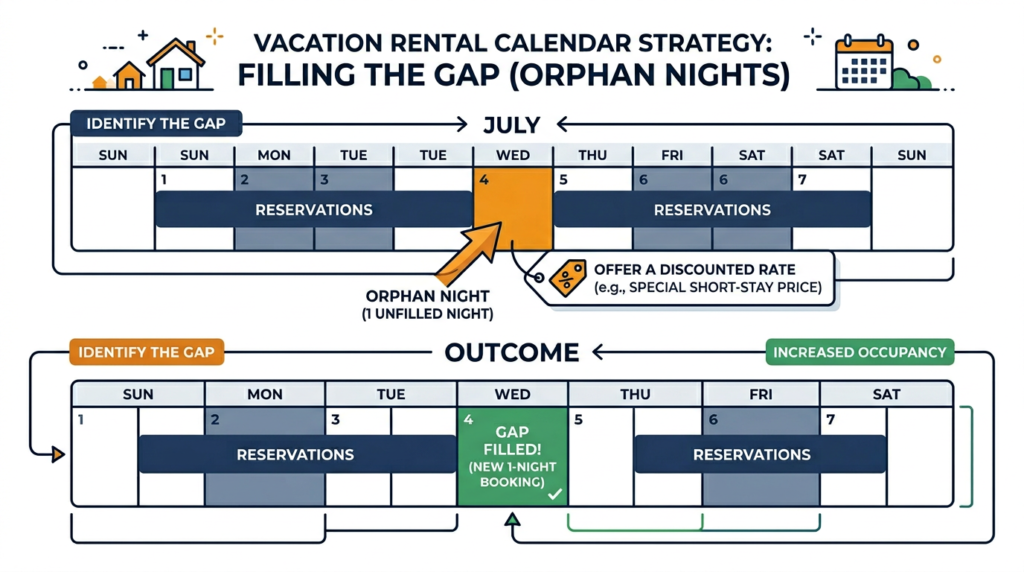
The right strategy is targeted discounting. When a single gap appears between two bookings:
- Identify it early (ideally the moment the surrounding reservations confirm).
- Drop the rate enough to make the single night attractive: typically 20–35% below your standard rate for that period.
- Set a one-night minimum stay rule for that specific gap, if your platform supports it.
Modern pricing tools can automate this entirely. The tool detects the gap, calculates the discount, and updates the rate without requiring manual intervention. Homesberg handles gap-night detection and repricing automatically as part of its dynamic pricing engine, so orphan nights get addressed without a separate manual step. For hosts managing manually, a weekly calendar review to spot and reprice orphan nights is a worthwhile routine.
The revenue case is simple: a discounted gap night produces more income than zero. It also keeps your booking pace signals healthy, which has downstream effects on search ranking.
Step 8: Fee Strategy
Your cleaning fee and any additional fees are part of your effective nightly rate from the guest’s perspective. Platforms often show total-trip pricing in search results, so a $100/night listing with a $250 cleaning fee competes differently than a $140/night listing with a $60 cleaning fee, even if the week-long totals are similar.
Several pricing guides flag this as a commonly missed lever. Guests who filter search results by nightly rate may never see your listing if your cleaning fee is priced separately at a high level, because the total-price view puts you above their threshold.
Fee strategy considerations:
- Absorb part of cleaning costs into the nightly rate if your cleaning fee is high enough to filter you out of search results at common price points. The nightly rate shows in more prominent positions in search.
- Keep cleaning fees proportionate. A $100 cleaning fee on a $100/night studio pushes guests toward properties where the fee feels fair relative to the stay cost.
- Extra guest fees and pet fees are reasonable if clearly disclosed and proportionate. Guests expect them and generally plan for them. Excessive or surprising fees that surface late in checkout drive abandonment and negative reviews.
The goal is a fee structure that feels fair to the guest, reflects your real costs, and does not artificially suppress your search visibility at common price filters.
Pricing and Search Visibility: The Connection Most Guides Skip
A detail that most pricing discussions understate: your rate does not only determine what guests pay. It also influences where your listing appears in search results.
On platforms like Airbnb, pricing and search ranking are directly connected. A listing priced slightly above market for a given set of dates may appear lower in search results than comparable listings priced at market rate. Fewer guests see it. Fewer guests book it. Revenue per available night drops, even if the nightly rate looks strong.
The reverse is also true. A listing priced competitively relative to comparable properties tends to receive more search impressions, which drives more booking momentum, which in turn reinforces ranking strength.
This is what makes the relationship between pricing and visibility worth treating as a system rather than two separate variables. You can read more about the factors that drive this dynamic in our breakdown of vacation rental pricing factors.
Homesberg’s search-aware dynamic pricing directly addresses this by connecting rate decisions to real-time search ranking data. Rather than optimizing price in isolation, it factors in where a given rate places your listing in search results before setting it, so visibility and revenue move together rather than trading off against each other.
Putting It Together: The Monthly Pricing Loop
Pricing is not a one-time calibration. Markets change. Competitors enter or leave. Seasonal demand shifts. Your review profile improves. Your competitive position changes relative to new listings. An approach that worked in March may underperform in July.
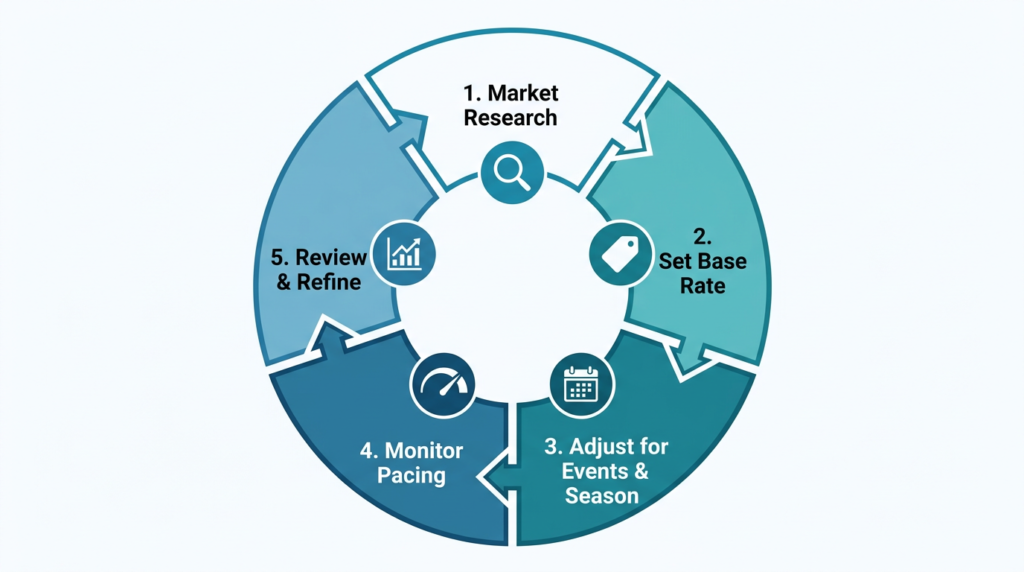
A practical monthly pricing routine:
- Market research: Scan your competitive set. Have new comparable listings entered your market? Have existing ones changed their pricing strategy?
- Calendar review: Identify high-demand periods, events, or holidays in the next 60–90 days. Confirm rates are set appropriately.
- Pacing check: Compare your current booking pace for upcoming dates against historical norms. Adjust rates where pace is running ahead or behind expectations.
- Gap audit: Identify orphan nights and confirm they are priced to fill.
- Performance review: Look at actual RevPAL (Revenue Per Available Listing Night) versus the prior period. Distinguish whether changes in revenue came from rate or occupancy, and adjust accordingly.
The hosts who consistently outperform their market are not those with the highest rates or the lowest rates. They are the ones who treat pricing as an ongoing process, maintain visibility into their competitive context, and make adjustments based on current conditions rather than stale assumptions.
Final Thoughts
Vacation rental pricing strategy is not a single decision; it is a set of interlocking decisions that compound over time. The base rate you set today shapes your booking momentum next week. The event premium you miss this quarter is revenue that cannot be recovered. The orphan nights you leave unpriced every month add up to a meaningful gap in annual income.
The bottom line: price from the market outward, not from your costs inward. Use dynamic adjustments for what changes quickly (lead time, pacing, events), and use structural decisions (seasonality tiers, length-of-stay rules, fee architecture) for what changes more slowly. Review regularly, and let your data tell you whether rate or occupancy is the variable to move next.
Pricing well is one of the most direct levers a host controls. It is worth the attention.
About Homesberg
Homesberg is a short-term rental management platform built for hosts who want data and control: market analytics, an Airbnb ranking tracker, search-aware dynamic pricing, and channel integrations in one place.
Start your free trial to see how your current pricing compares to the market and where the opportunity is.